

.svg)


.webp)


Social media marketing can be a growth engine or a resource drain, and for most businesses, it ends up being both at once.
That tension is exactly why this guide exists.
As a business owner, B2B marketer, or growth lead, you want to know whether social media is worth investing in, your time, or your team's attention, or if you shouldn't, but not in the form of a checklist of empty promises or the obligatory "don't do this" list.
Because the honest truth is this: social media marketing works exceptionally well when it's the right channel for your goals. And it quietly bleeds time and money when it isn't.
In this guide, we break down the real advantages and disadvantages of social media marketing, what it genuinely delivers, where it consistently falls short, and how to think about the trade-offs before you commit.
What Is Social Media Marketing?
Social media marketing is the practice of using social platforms, such as Facebook, LinkedIn, Instagram, TikTok, YouTube, and others, to build brand awareness, engage your audience, and drive business outcomes like leads, traffic, and sales.
It is simply creating and sharing content that meets the needs of your audience and your objectives. That type of content can spark conversations, answer questions, highlight your product, or simply be there to remind your audience who you are.
What's changed in recent years is the pace and complexity of the discipline. Short-form video has become the dominant content format across nearly every platform. AI tools now assist with everything from content ideation to ad targeting to performance analysis. And the line between organic social media and paid promotion has blurred significantly; most serious strategies use both.
Before we get started, one more thing to note: there are distinct approaches to social media marketing, depending on your business. For B2C, it's usually exposure, engagement, and transactions. For B2B companies with longer buying cycles, harder-to-reach decision makers, and longer to build trust, the approach needs to be different. For this, we have a special guide to B2B social media marketing.
For now, let's start with where social media actually stands today and why both its advantages and disadvantages matter more than ever.
The State of Social Media Marketing in 2026
To understand the real advantages and disadvantages of social media marketing, it helps to start with where things actually stand, because the landscape has shifted considerably in recent years.
According to DataReportal's Digital 2025 Global Overview Report, there are now over 5.24 billion social media users worldwide, more than 63% of the global population. That number has more than doubled over the past decade and continues to grow.

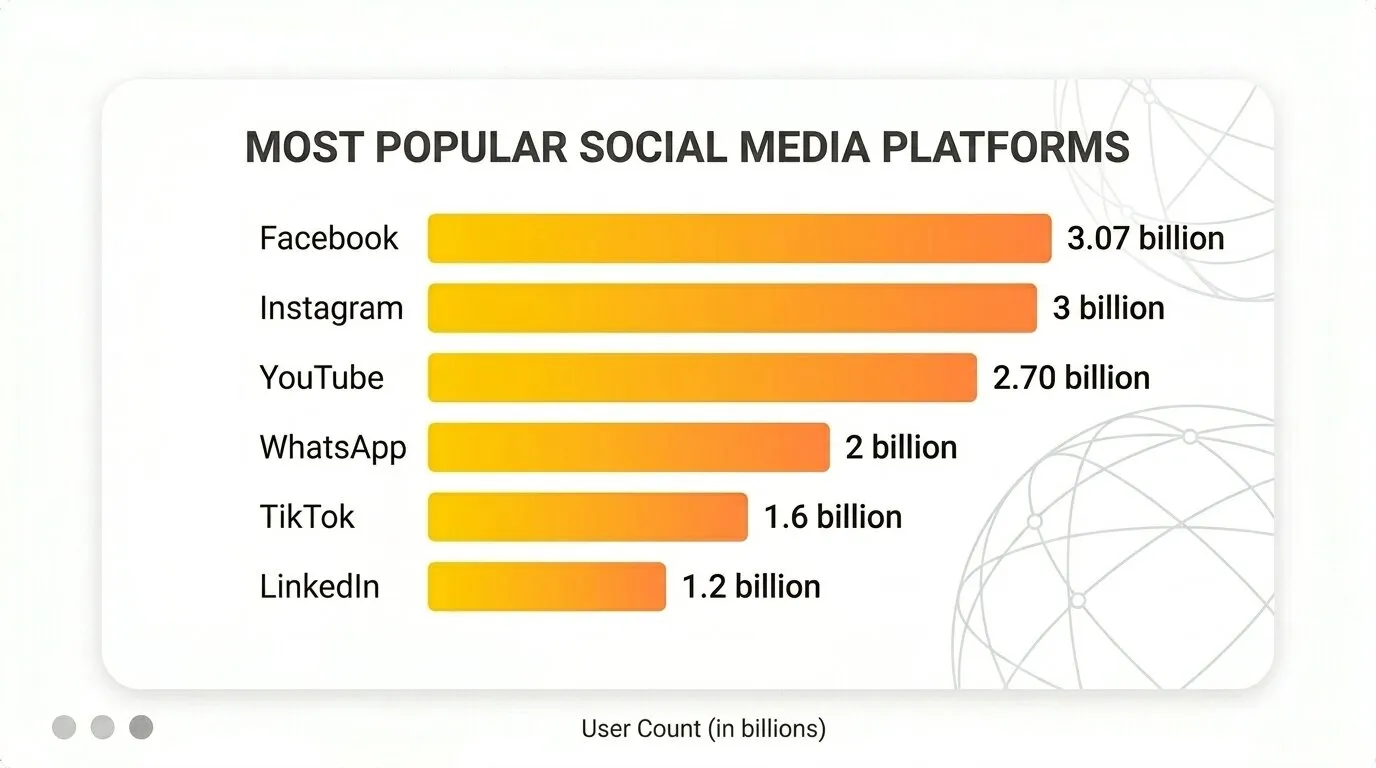
Here's how the major platforms break down by active users in 2025:
- Facebook: 3.07 billion monthly active users, making it the world's largest social network
- YouTube: approximately 2.70 billion monthly active users, and the second most-visited website on the internet after Google
- Instagram: approximately 3 billion monthly active users, up significantly from just a few years ago
- WhatsApp: more than 2 billion users, businesses heavily utilize it to reach customers directly, particularly outside of North America.
- TikTok: has about 1.6 billion monthly active users; however, its sustainability in various Western markets is questionable owing to the persistent regulatory threat.
- LinkedIn: over 1.2 billion members, and the most important platform for B2B marketing by a significant margin
What's changed beyond the numbers:
Social media marketing in 2026 involves three shifts that are relevant to your strategy.
To start with, the default content format is now the short-form video on almost all platforms. Reels, Shorts, and TikTok-type content always win over static posts in terms of organic reach and interaction. Unless video is included in your content mix, you are already disadvantaged.
Second, AI has become embedded in the everyday work of social media marketing, from content creation and ad targeting to performance analysis and audience segmentation. This has made it easier to produce content at scale, but it has also raised the bar for standing out in an increasingly crowded feed.
Third, social commerce has become a legitimate source of income. TikTok Shop, Instagram Shopping, and others have transformed feeds into physical sale points, a trend that has been most developed in the B2C business model but has also become more applicable to the B2B ones.
To the businesses that have to consider where to invest, the platform you settle on is just as important as the strategy you develop on it. And that brings us to what this guide is really about: the genuine advantages and disadvantages of social media marketing that should inform that decision.
Advantages of Social Media Marketing
Used well, social media marketing delivers real, measurable advantages. Here are the ones that matter most.
1. Massive Audience Reach
The sheer scale of social media is unlike anything else in the marketing toolkit. With over 5.24 billion people using social media worldwide, the potential to get your brand in front of the right people is genuinely extraordinary.
What makes that reach valuable is not only the numbers, but the variety. Various platforms are appealing to different demographics, working contexts, and purchasing desires. A properly placed campaign on the appropriate platform can position your brand before the very segment that is of interest to your business, not the general population, but the right segment.
2. Cost-Effective Compared to Traditional Marketing
Social media is one of the easiest marketing methods ever. It takes time to make an account and post organic content for free, which is something that traditional advertising simply cannot compete with, no matter what the size of the business.
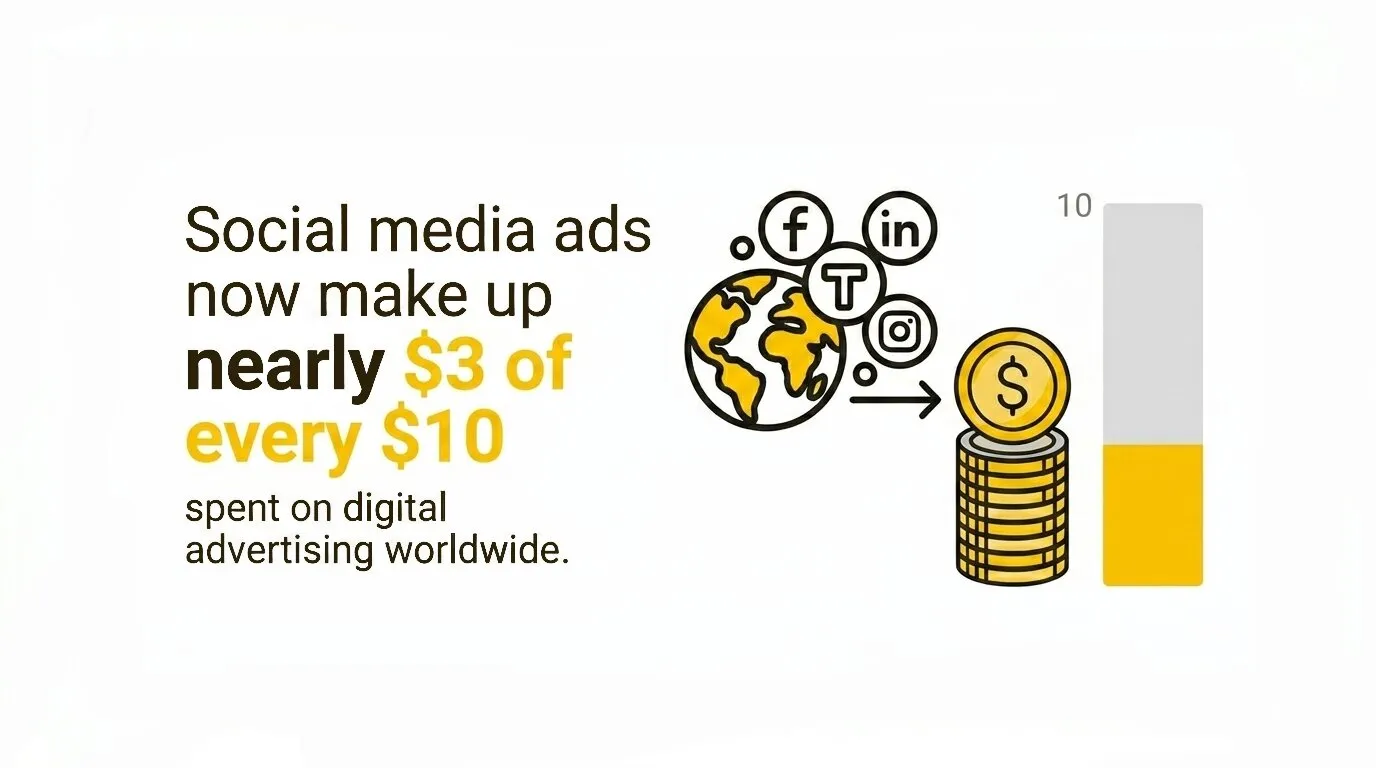
The value proposition holds in paid promotion when you move into paid promotion. In the world today, social media advertisements should contribute almost $3 in each $10 of digital advertisement, and the targeting level purchased by the ad dollars is incomparable to TV, print, or radio. In the case of B2B companies, specifically, LinkedIn has features where you can target by job title, size of company, and seniority, in that you are now reaching decision-makers as opposed to a mass audience who may not have any interest in what you are selling.
That said, "free to start" doesn't mean free to sustain. Organic content requires real-time and creative investment, and organic reach has declined significantly across most platforms in recent years. The cost advantage is real, but it's most valuable when paired with a clear strategy.
3. Highly Targeted Paid Advertising
One of social media's most powerful advantages over other advertising channels is precision targeting. Meta's ad platform allows you to target users by age, location, interests, purchase behavior, job title, and even life events. LinkedIn lets B2B marketers filter by seniority, company size, industry, and specific job functions. TikTok and Pinterest offer interest- and behavior-based targeting that is particularly effective for product discovery.
AI has enhanced this capability to a greater extent. Advantage+ campaigns at Meta are automated with machine learning and have resulted in a 17 percent reduction of cost per acquisition compared to campaigns managed manually. The same AI-based optimization tools have become the norm in most of the larger platforms, which simplifies achieving the right audience at the right time and also enhances performance even without the need to constantly be manually adjusted.
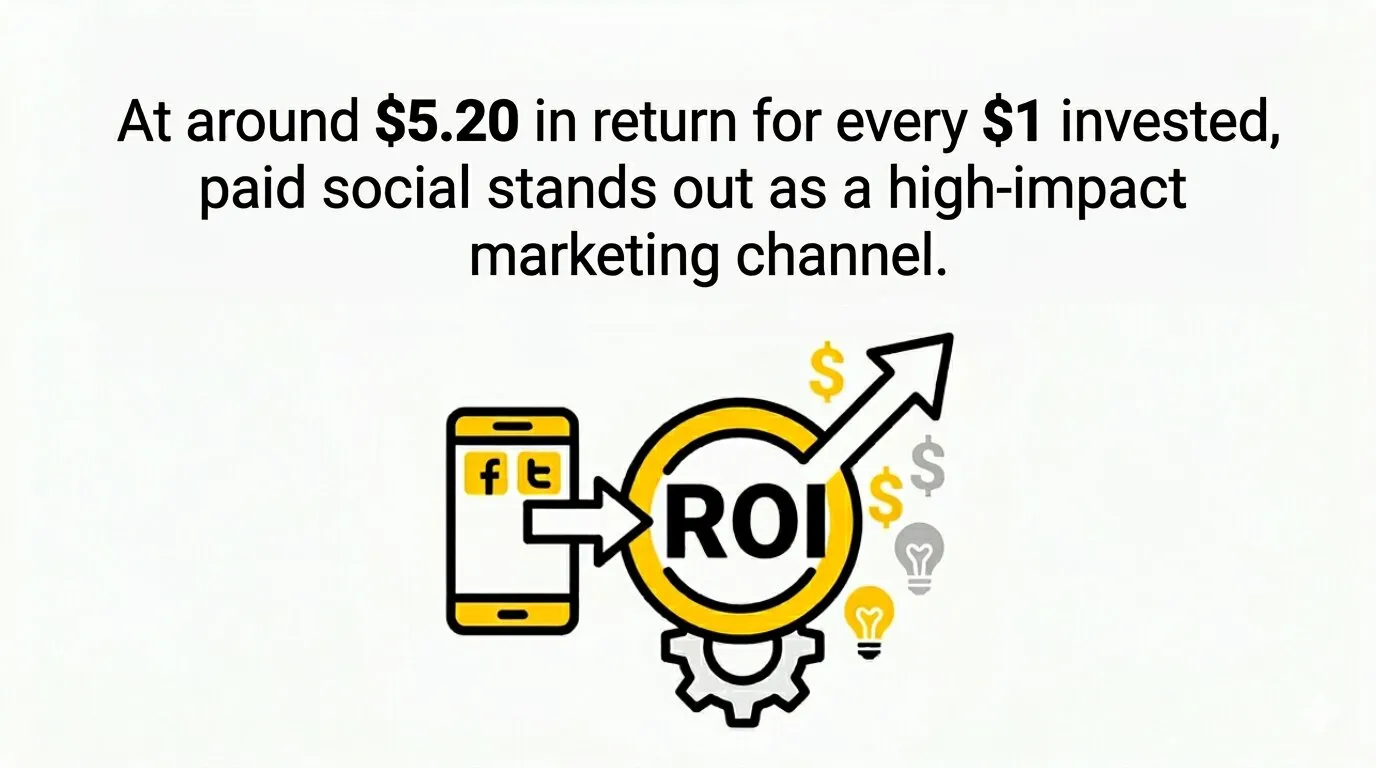
The outcome: the average payback period on investment in paid social media advertising is about 5.20 per dollar, which is a mark to make a strong argument that paid social is a component of a disciplined marketing mix.
4. Direct Access to Your Audience
Social media gives you something that most marketing channels don't: a direct, two-way line to the people who follow, engage with, and buy from you.
When someone chooses to follow your brand account, they're signaling interest. That signal is valuable in several ways:
- You have a better understanding of your audience. Demographics, activity trends, and discussion boards will inform you of what your followers are interested in, usually more truthfully than polls or focus groups.
- You are able to serve customers at a faster rate. Social platforms enable the brand to fix problems, answer queries, and respond to feedback instantly, which has a direct impact on satisfaction and loyalty.
- You see how your brand is perceived. Comments, mentions, and shares are an unfiltered window into how people actually talk about your business. That's intelligence you can act on.
- You build community. LinkedIn groups, Instagram DMs, and Facebook communities let brands move beyond broadcasting and create spaces where their audience connects with the brand and with each other.
This is a direct channel, which becomes more valuable the more frequently you use it. Brands that appear consistently and genuinely in these locations create the type of trust that is not possible on paid ads.
5. Real-Time Performance Measurement
Social media marketing will inform you on what is working, unlike a billboard or a TV spot, which may take hours after posting.
All significant platforms have their native analytics: reach, impressions, click-through rates, saves, shares, follower growth, and conversion tracking. Such tools as Meta Business Suite or LinkedIn Campaign Manager go further as they enable you to trace the performance across platforms, compare with the industry averages, and assign social activity to the pipeline and revenue.
This is among the strongest strengths of social media marketing compared to traditional channels due to its measurability. You are able to test a post, view its performance, and make changes in real time, which saves wasted spend and enhances campaigns on-the-fly. In B2B teams where marketing investment may require justification to the leadership, this data trail is far easier to compile.
6. Brand Awareness at Scale
The establishment of brand recognition previously consumed television funds. That has changed the equation with social media.
Consistent and quality content on the right platforms creates familiarity, and familiarity creates conversions. A study indicates that 81 percent of consumers acknowledge that the content they view on social media has led them to make an impulse purchase. That effect compounds over time: the more people see your brand in their feed, the more naturally they think of it when the need arises.

In the case of B2B brands, social media brand awareness works in a different way but is equally important. The type of credibility that saves you sales time and pre-warms your prospects before your sales team even hits the call button is built through the content of thought leadership on LinkedIn, regular commentary within your industry niche, and regular appearances within the feeds of decision-makers.
It is simple mechanics: social platforms are created to share. Your followers can spread your content to their circles when it resonates with them, and this kind of organic amplification is impossible to achieve on any other channel in such a natural manner.
7. Market and Competitor Intelligence
Social media is one of the richest sources of real-time market intelligence available to businesses today, and most brands are only using a fraction of what's available.
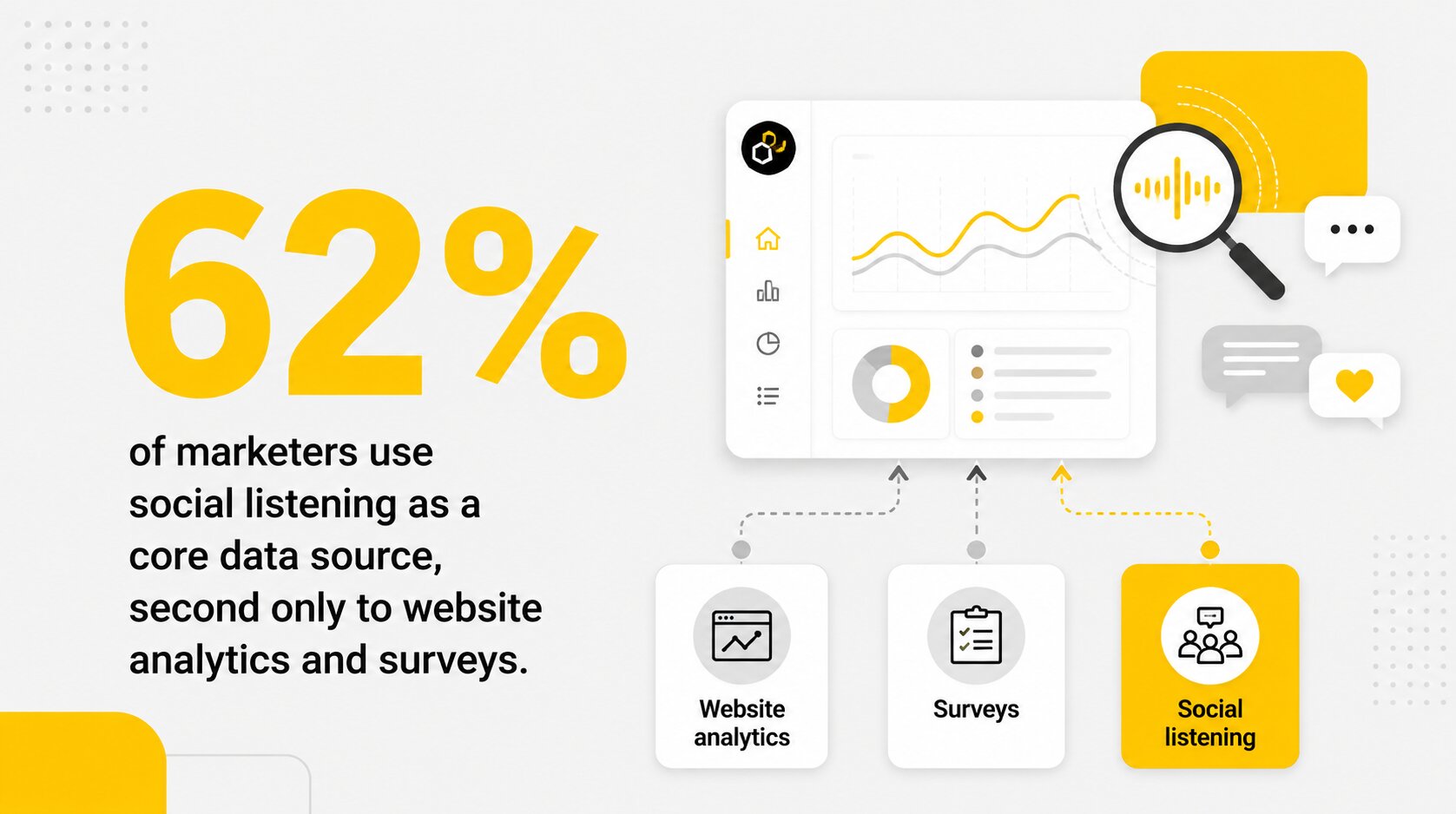
Social listening: It is common practice to listen to mentions, conversations, and sentiment on platforms for your brand, competitors, and industry. 62 percent of marketers consider social listening to be a key data source, tied with website analytics and surveys, as of 2025. With features such as Talkwalker or Hootsuite Insights, you can monitor thousands of conversations across the board, catch up with trends before they take off, and gain insight into what people are genuinely saying about your product, even the 82% of brand conversations that occur outside of your brand channels.
Competitor monitoring is the other side of the same coin. Social media is largely public, which means you can watch how your competitors show up: what content they're posting, how their audience responds, what complaints they're receiving, and which campaigns they're running. Meta's Ad Library lets you see exactly what ads any brand is running on Facebook and Instagram at any time, a level of competitive transparency that simply doesn't exist in offline advertising.
For B2B companies, this intelligence is particularly valuable. Understanding where a competitor is investing content effort and where the gaps are is a direct input to smarter positioning and campaign strategy. If you want to see how leading B2B teams turn social intelligence into pipeline, our guide to B2B lead generation strategies for social media covers exactly that.
8. Social Commerce Opportunities
The rise of social commerce: the capability to make purchases and sell goods directly through social networks, without having the user leave the application, is one of the most prominent changes in social media marketing in the last several years.
It is no longer a niche feature. The sales of US social commerce are expected to reach more than 87 billion in 2025 and over 100 billion in 2026. TikTok Shop is currently alone covering almost 20 percent of total US social commerce, as Instagram Shopping and Facebook Marketplace occupy the market. By the year 2025, more than 100 million Americans will have purchased something through social media, almost half of the social media users in the US.
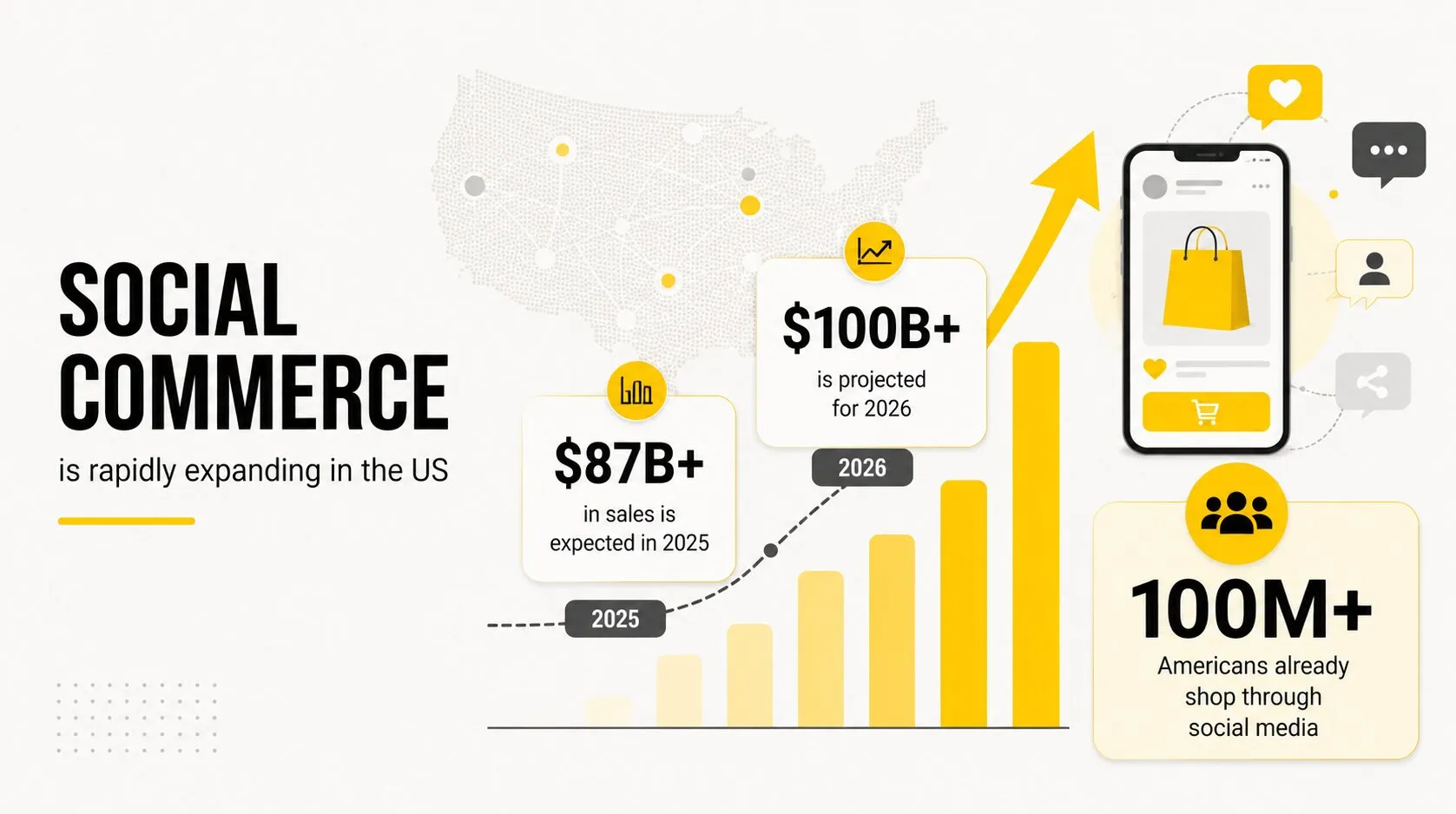
In the case of product-based companies, it is a shorter route to purchase: engaging or informative content can be turned into a sale immediately after reading, without the hassle of sending the user to another location. In the case of B2B firms, the social commerce paradigm is less direct but more topical, especially as LinkedIn builds its commerce functionality and social evidence (reviews, case studies, testimonials) becomes an increasingly important factor in business buying.
9. Community Building and Customer Loyalty
Social media is, at its foundation, a social environment, and that gives brands an opportunity that advertising alone cannot provide: the chance to build a genuine community.
Dividends are always seen among brands that invest in this. 73% consumers who use social media indicate that they will switch to a rival brand in the event a brand fails to reply on social, and that means responsiveness is not a nicety, but a survival strategy. The converse is also correct: brands appearing, interacting in an authentic way, and considering the social as a two-way channel and not a broadcast medium develop the form of loyalty that persists beyond specific campaigns.
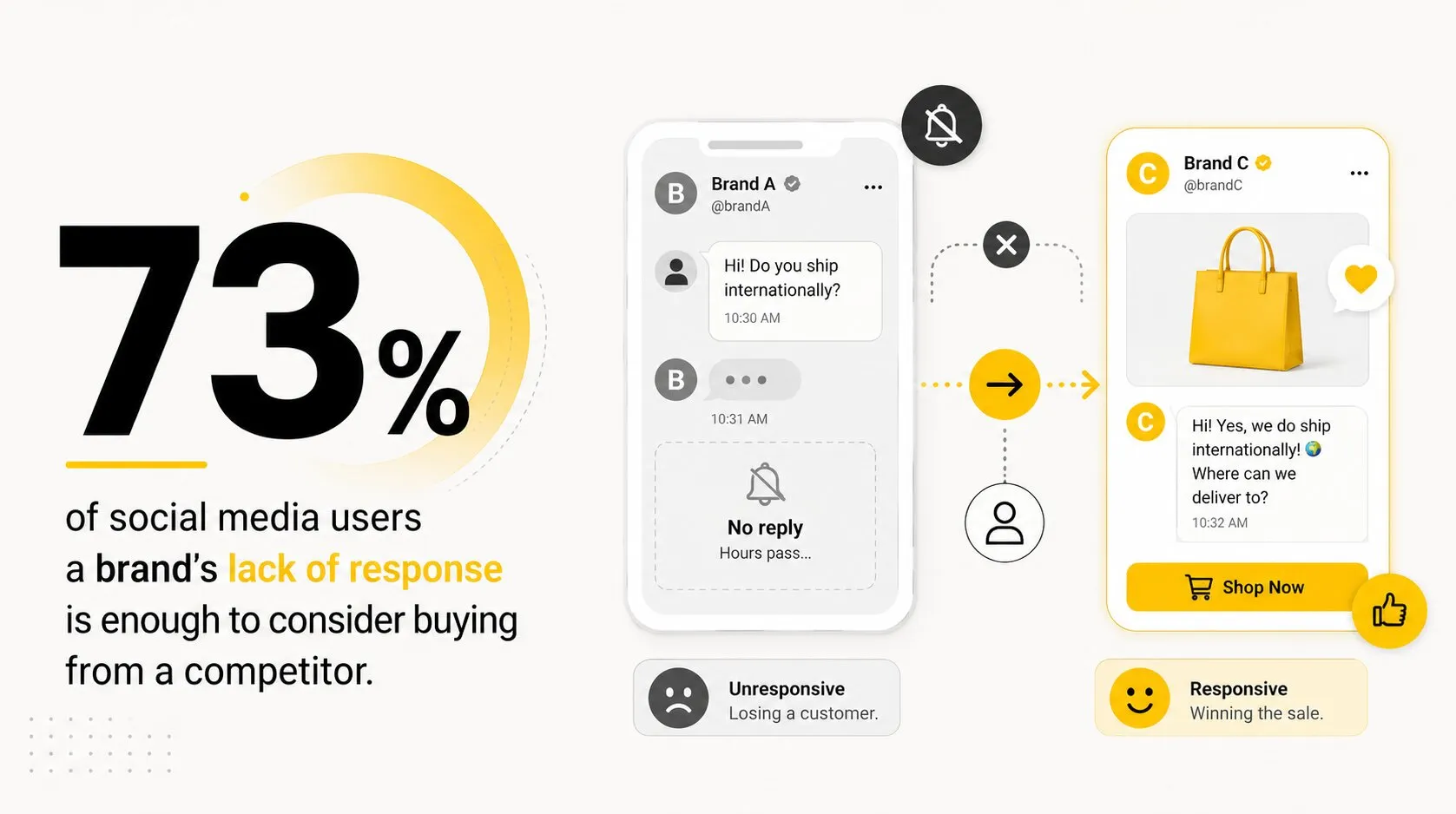
Practically speaking, this means responding to comments and DMs, acknowledging feedback (positive and negative), and creating content that gives your audience a reason to return, not just content that promotes your products. For B2B brands, this might look like publishing genuinely useful industry insights on LinkedIn, hosting live Q&A sessions, or building a community group around a professional topic your buyers care about. The mechanism differs from platform to platform, but the underlying principle is the same: people stay loyal to brands that make them feel seen and valued.
10. AI-Powered Efficiency
In 2026, AI is one of the most powerful tools at the disposal of social media marketers, not a substitute for creative and strategic thinking, but rather a force that amplifies it.
89.7% of marketers now use AI tools multiple times weekly for social media tasks, from drafting captions and brainstorming content ideas to analyzing performance data and optimizing ad targeting. The time savings are real and material. What previously required a full day of manual reporting can now be generated in minutes. Creative testing that once required weeks of iteration can be accelerated through AI-assisted copy and image variants.
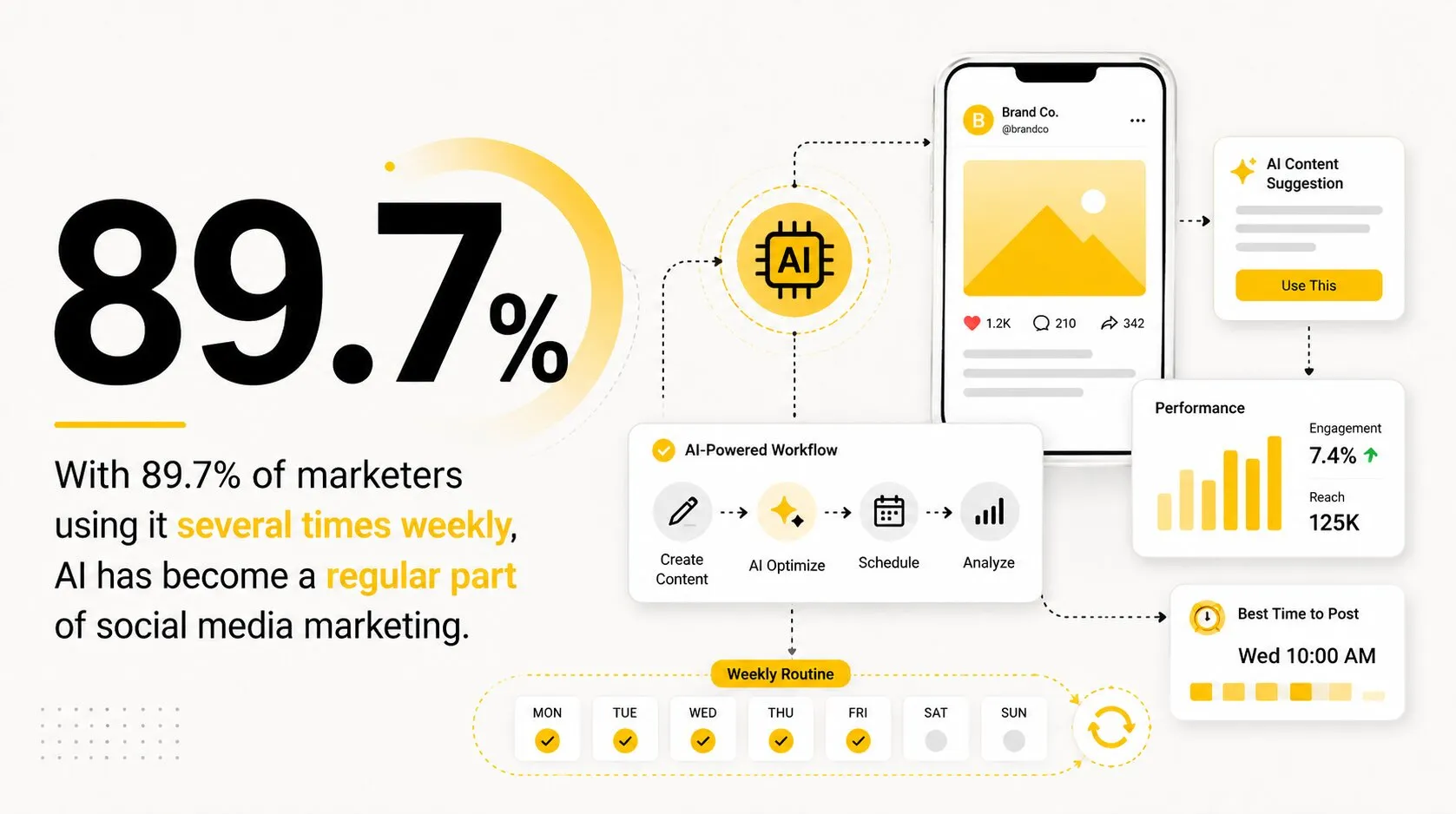
On the paid side, AI-powered campaign optimization has become mainstream. Automated bidding, predictive audience targeting, and dynamic creative tools are now standard features across Meta, LinkedIn, TikTok, and YouTube, and brands using AI-powered budget optimization tools have seen up to a 28% reduction in cost per conversion.
The only real downside to mention: AI has also made creating content at scale easier than ever, which has led to an increased volume of content on the platforms. The advantages in efficiency are genuine, but best when the content itself, the ideas, the point of view, the voice, are clearly human.
Disadvantages of Social Media Marketing
Social media marketing is not without its pitfalls. Knowing these disadvantages upfront is what separates brands that use it strategically from those that get burned by it.
1. Time and Resource Intensity
Social media marketing is a free marketing platform to begin with, but it is not free to run effectively. The investment time alone is significant. It's not just about making content, it's about managing multiple platforms, seeing comments and messages, analyzing performance data, staying updated on algorithm and format changes, and more.
To companies that lack a dedicated social media team, that would be an extra burden on an already overstretched individual. And the financial investment amounts to so much money when you add in content creation, management tools, and paid promotion. The average amount of money small businesses spend on social media marketing is between 1,500$ and 5,000$ per month when the expenditure is added to the agency fees or management fees. It is typically much more expensive for mid-sized companies.
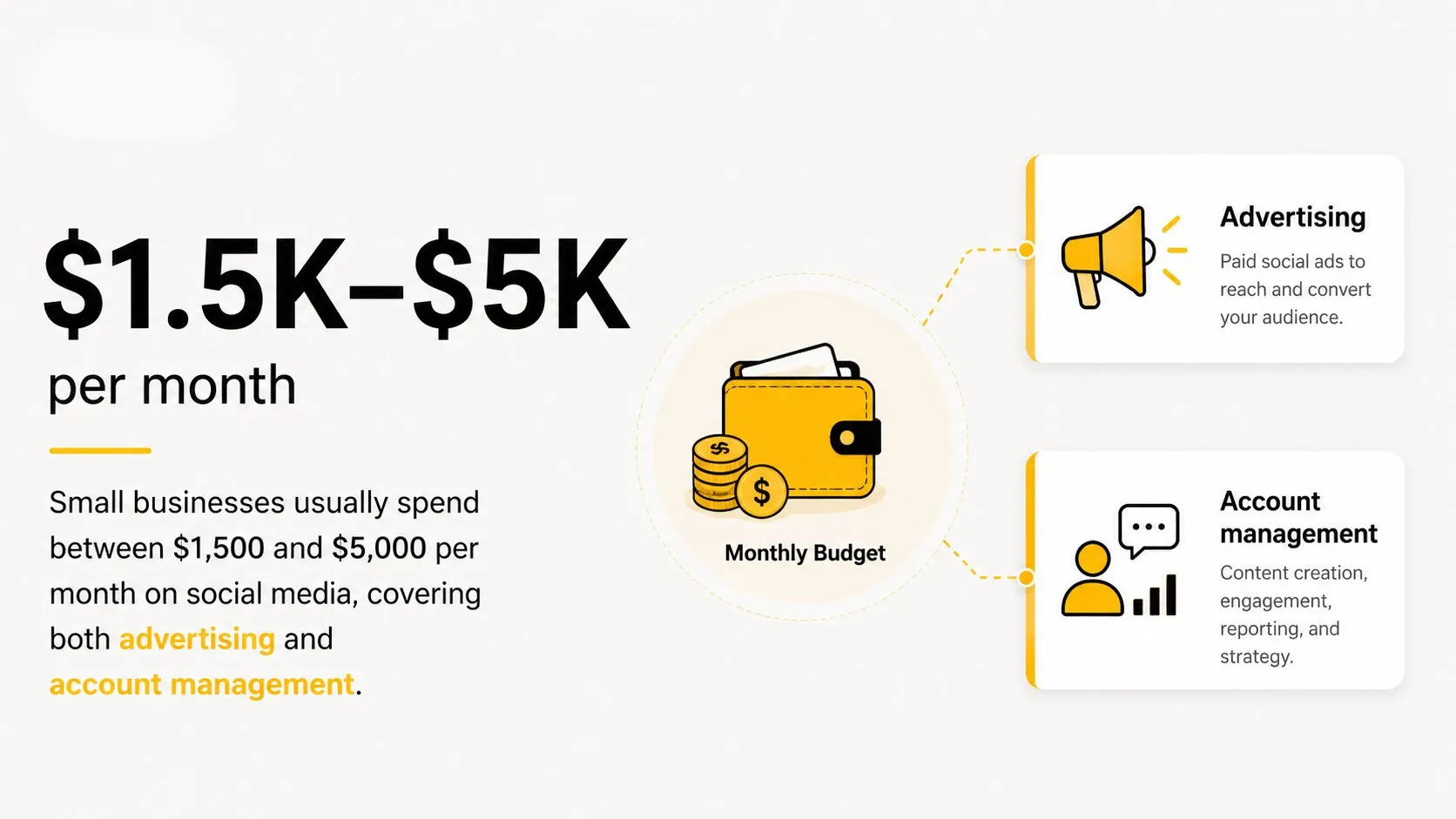
AI tools have taken part of this load, aiding in content drafts, schedule, and simple performance reporting. However, they do not preclude the necessity of planning, human decision-making, and imagination. Time cost is actual, and one of the most frequent causes of stalling of social media marketing efforts is underestimating the time cost.
2. Declining Organic Reach
Among the most drastic changes in social media marketing in the last few years, one must mention the drastic drop in organic reach, the percentage of your followers who will see your content without being promoted.
The figures are alarming. The average engagement rate was as low as 0.2%, and the average organic reach was as low as 1.37% on Facebook throughout the year of 2024. The organic reach on Instagram fell by 18% year-over-year in 2024, while the average brand post saw a 4% reach of followers. In other words, if you have 10,000 fans on Facebook and post something today, fewer than 200 are likely to see it organically.
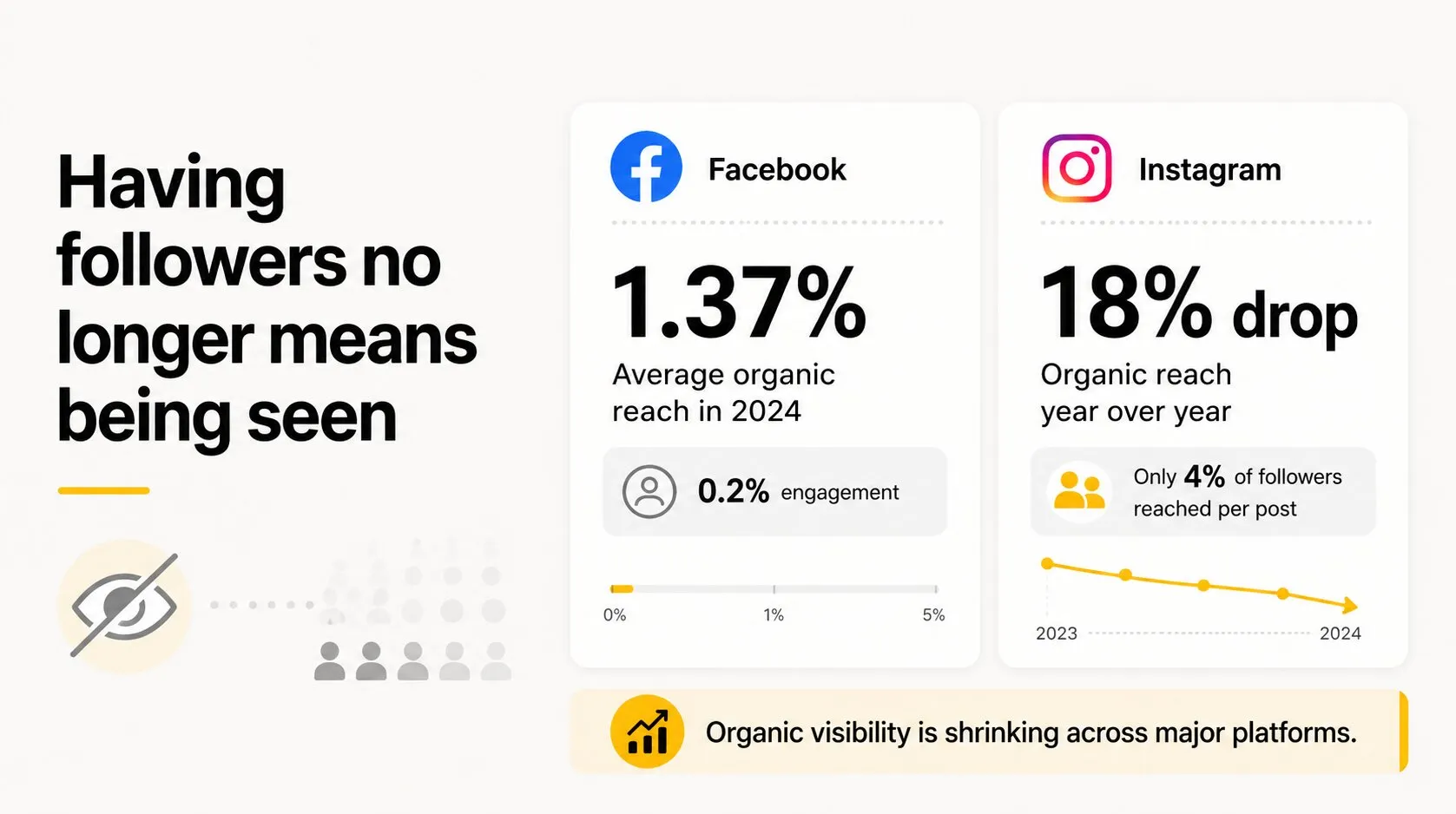
This has significant implications for any business that has built its social media strategy around organic content. What once delivered meaningful reach is now a signal to your existing audience at best. Growing your reach through organic content alone has become increasingly difficult and, on most platforms, increasingly requires paid amplification to achieve results that were once achievable for free.
3. Algorithm Dependency: Building on Rented Land
All of your business's social media accounts are on someone else's property. The company's algorithm, its rules, its distribution, and - ultimately - its users' access to your content are in the hands of the social media platform. This presents a strategic weakness that can be hard to see in the good times.
The real risks are practical. Your reach can be reduced by just updating your algorithm at night. Any platform may alter its terms of service, limit the type of content on your page, or demote business pages to personal content at any time. Your account may be flagged, limited, or even suspended, both unintentionally and with no notice.
This dynamic has a name in digital marketing circles: Your social media followers, on Instagram, LinkedIn, or TikTok - aren't yours. You don't know who they are and can't reach them unless the platform lets you. The companies that are best positioned to manage this risk are those that use social media as one of their channels, but not as their sole channel, and build audience-owned assets such as email lists and content sites, in addition to social media.
4. Vulnerability to Negative Feedback and PR Crises
Social media is a communal platform, without any filters on communal platforms. One complaint, an ill-chosen post, or an executive gaffe or a misunderstood campaign can get a lot of negative attention in hours, and screenshots ensure that even after the post is deleted, the story remains.
The actual risk is the rate of escalation. In early 2024, the Kellogg CEO proposed that families dine on cereal at night to overcome food prices that are increasing during a CNBC interview. Soon, the comment was cut and posted to social media, the hashtag #BoycottKelloggs began to trend on TikTok, and the backlash went viral way beyond the original interview. The silence of the company during the initial hours was just further fuel for the negative cycle.
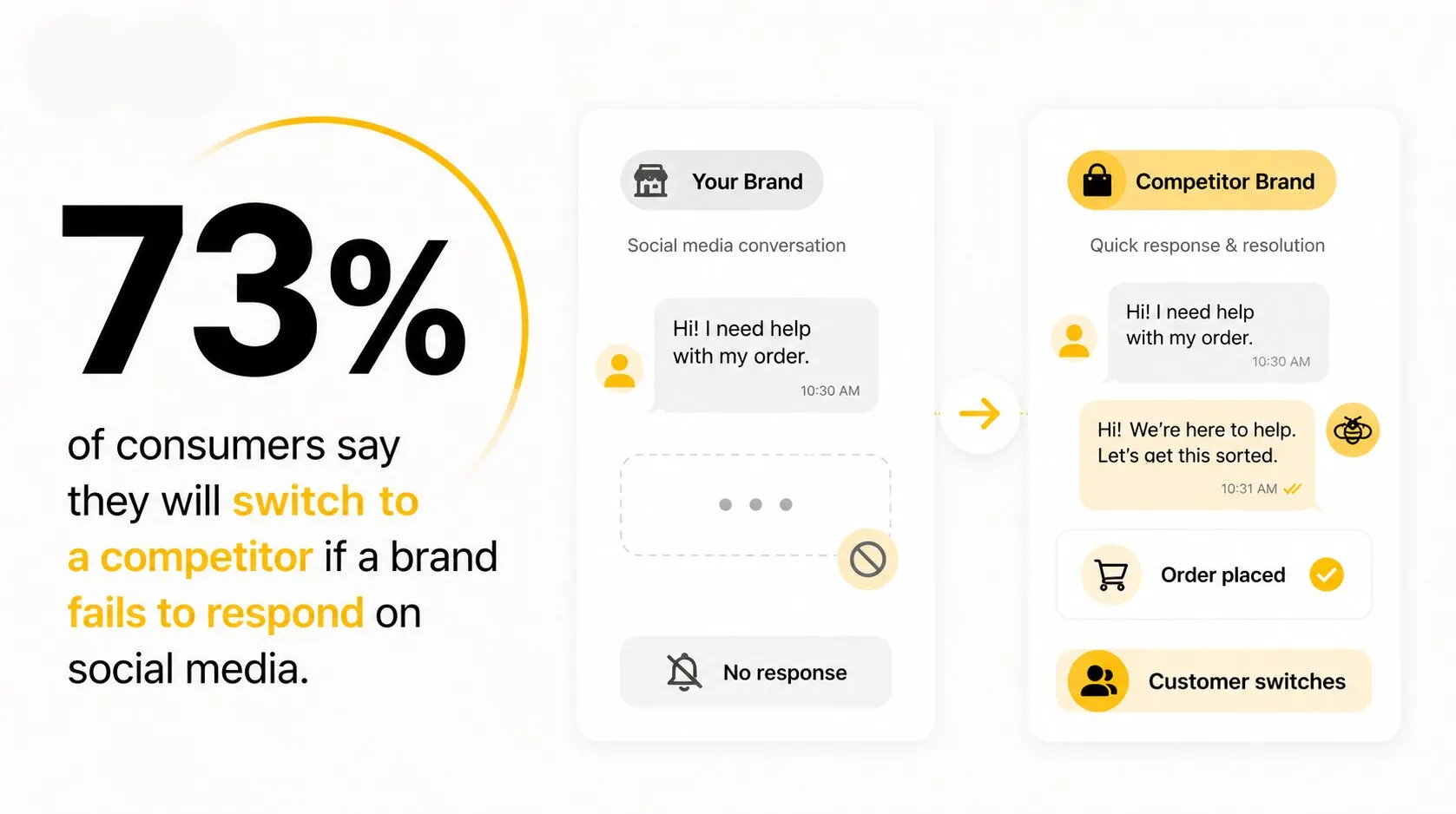
The takeout message isn't that brands shouldn't use social media, it's that they should be ready for the worst. This means having a crisis management plan ready to go: pre-agreed response frameworks, escalation procedures, a designated person to respond to issues, and a willingness to respond fast without making the situation worse. A recent Index shows that 73% of consumers will switch brands if they don't receive a response on social media, so there's no such thing as no response.
5. Misinformation and AI-Generated Fake Content Risks
Brand misinformation has always been an issue in social media, but there's a new and bigger threat from AI-generated content. Where it used to be a problem of misleading text only and fabricated screenshots, now we have AI-generated video, audio, and images that are harder to detect.
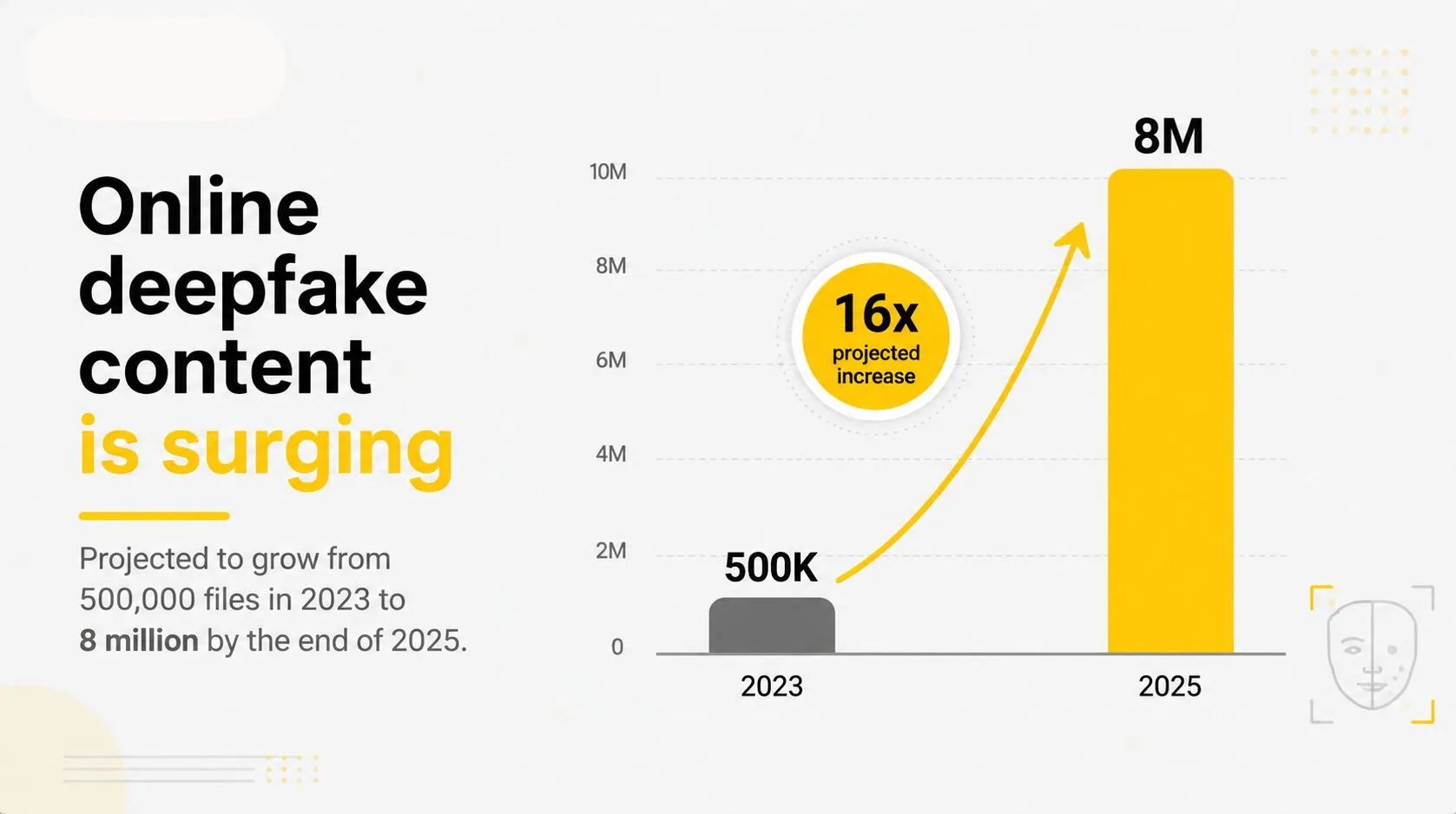
The volume of online deepfake files jumped from 500,000 in 2023 to 8 million by 2025, a 900% annual growth rate, says cybersecurity company DeepStrike. This poses a new challenge for brand reputation: fraudulent content that appears to be real is shared widely and acted upon before the facts are righted.
The 2024 brand crisis analysis from Cyabra illustrated a related and growing pattern: fake social media profiles amplifying negative campaigns against brands. In separate incidents involving Jaguar, Nestle, and Walmart, between 20% and 46% of the profiles pushing negative hashtags were found to be fake, artificially inflating the appearance of widespread consumer backlash. What looks like a PR crisis may, in part, be a coordinated disinformation campaign.
Brand protection is an important action that not only involves monitoring your name, products, or even CEOs, but also monitoring conversations about them. Social media listening and sentiment analysis tools can assist in spotting spikes in volume or sentiment that may indicate a snowballing misinformation situation while it's still gathering momentum. The sooner you detect the spread of a misinformation narrative, the sooner you can act to address it.
6. Content Saturation and Standing Out
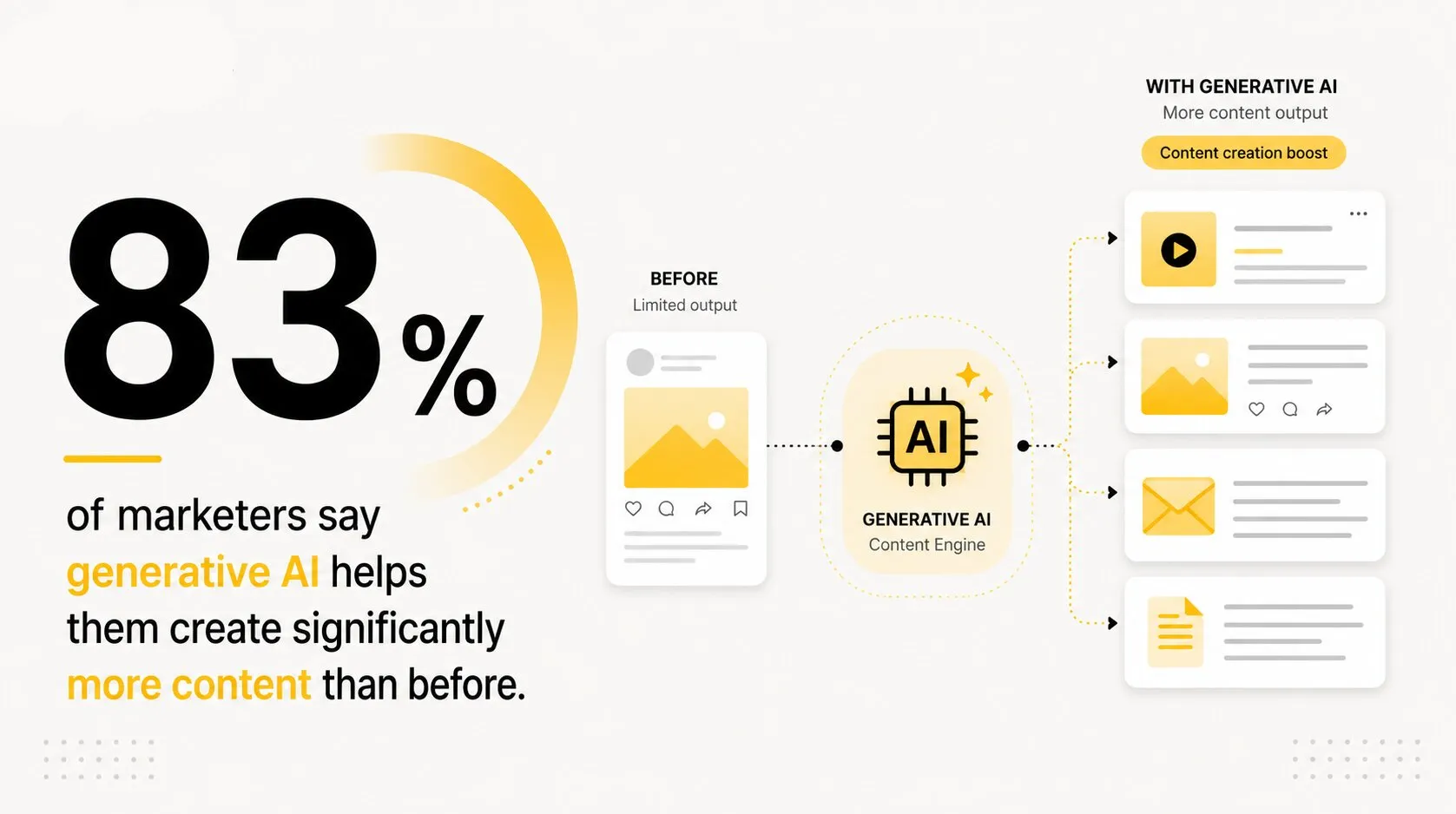
There's more content than ever on social media platforms, and AI has helped make the problem much worse. 83% of marketers now report that generative AI has led to a much greater volume of content creation, and, according to one analysis, AI generated more words than humans for the first time in late 2025. This means more content than ever on the feeds, and less interest from viewers in what they actually consume.
The consequences show up directly in performance data. On TikTok, average views per post fell 17% year-over-year despite brands posting 22% more frequently. On Instagram, post reach dropped 31% over the same period. More content is being published to reach fewer people per post.
More than 80% of consumers already feel that AI-generated content is making their social feeds more saturated than they already are, according to a Survey. Audiences are growing more fatigued, more selective, and more skeptical of content that feels generic or formulaic. In that environment, brands that compete on volume alone are likely to find themselves spending more and achieving less. Differentiation, through genuine perspective, original insight, and authentic voice, has never been more important, or more difficult to sustain at scale.
7. Security and Account Takeover Risks
Social media accounts for businesses are enticing targets for hackers, and the risks have increased significantly. The number of social media and email hacking incidents reported to Action Fraud has increased from 23,000 in 2023 to 35,436 in 2024, a 54% annual increase. Social media account credentials are now over 60% of all hacking incidents via phishing scams, and ecommerce lose an average of $200,000 per cyberattack due to hacked social media accounts.

The attack methods have become more sophisticated. A notable wave of account takeovers in 2023 and 2024 involved phishing apps disguised as "ad optimisation" plug-ins. Meta confirmed that millions of accounts, including many verified brand pages, were compromised after employees clicked fake login portals that appeared identical to Facebook Business Manager. In a typical attack of this kind, the hijacked page is used to post scam content to the brand's real followers within minutes of the breach. By the time admins notice, the reputational and financial damage is already done.
For added protection, especially when managing multiple accounts or accessing platforms from different regions, many businesses use a residential VPN to reduce the risk of suspicious login flags and unauthorized access.
Practical precautions every business should have in place:
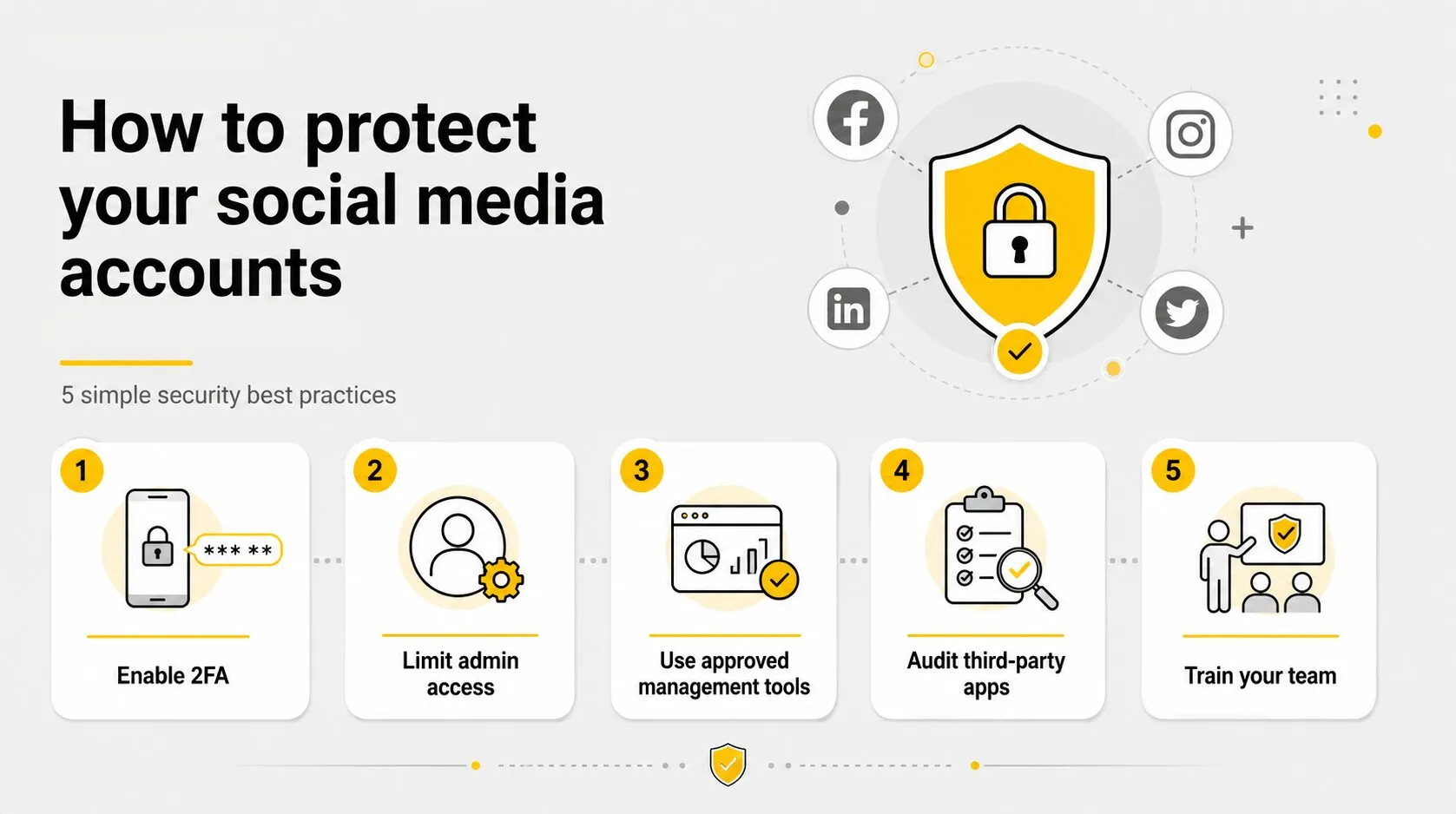
- Enable two-factor authentication (2FA) on every platform account and every email address linked to those accounts
- Limit admin access to a minimal number of trusted team members, and remove access promptly when employees leave
- Use an approved social media management platform rather than logging directly into platform interfaces on shared or unmanaged devices
- Audit connected third-party apps regularly and revoke access to any tool that is no longer actively used
- Train your team to recognize phishing attempts, particularly fake "account suspension" notices, which are the most common attack vector
8. ROI Can Be Difficult to Measure
One of the persistent frustrations with social media marketing, particularly for B2B companies, is the difficulty of connecting social media activity to concrete business outcomes. Engagement metrics are easy to track. Revenue attribution is not.
An Index reveals that although 65% of marketing leaders feel it is important to show how social media campaigns relate to business objectives, only 30% marketers actually measure the ROI of social media. The disconnect between what's expected and measurable is a true operational hurdle, particularly where they must convince leadership to allocate their budget.
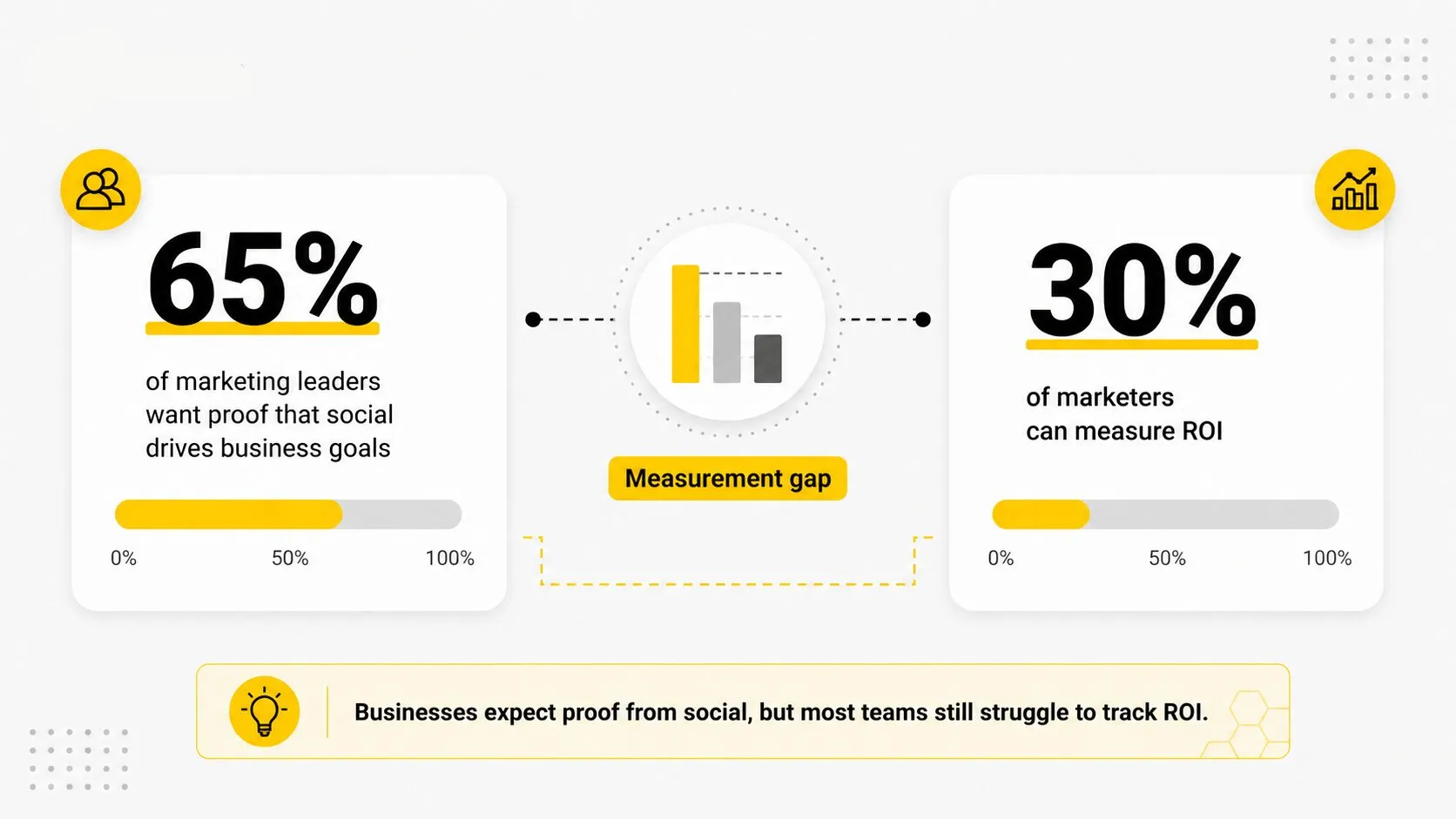
The problem is structural. Social media often plays a role in the buying process over time via multiple touchpoints, making it difficult to attribute. A buyer might see a LinkedIn post about you, visit your website for more information, see a retargeted ad, and then purchase through email, meaning the social media post is responsible for their purchase, but won't get the credit in many attribution models.
Without the right tracking infrastructure and attribution framework in place, social media investment can appear to produce less than it actually does. For a deeper look at how to build that framework, our guide to B2B digital marketing ROI walks through the measurement approaches that actually work.
9. Platform Instability
Betting your entire marketing strategy on any single social media platform is a risk that recent years have made impossible to ignore.
TikTok's situation is the clearest current example. Despite reaching nearly 1.6 billion users globally, the platform has faced sustained legislative pressure in the United States and regulatory scrutiny in parts of Europe. Brands that built significant audiences and advertising strategies around TikTok have had to maintain contingency plans, and those that didn't were caught flat-footed during periods of uncertainty.
The transformation of X (formerly Twitter) since 2022 is a different story. Once a key platform for real-time customer engagement, sharing brand content, and industry news, the platform has undergone considerable changes in user demographics, advertiser trust, and brand safety measures. A number of brands have been cutting back their spend, reallocating funds to LinkedIn, Instagram, and new platforms.
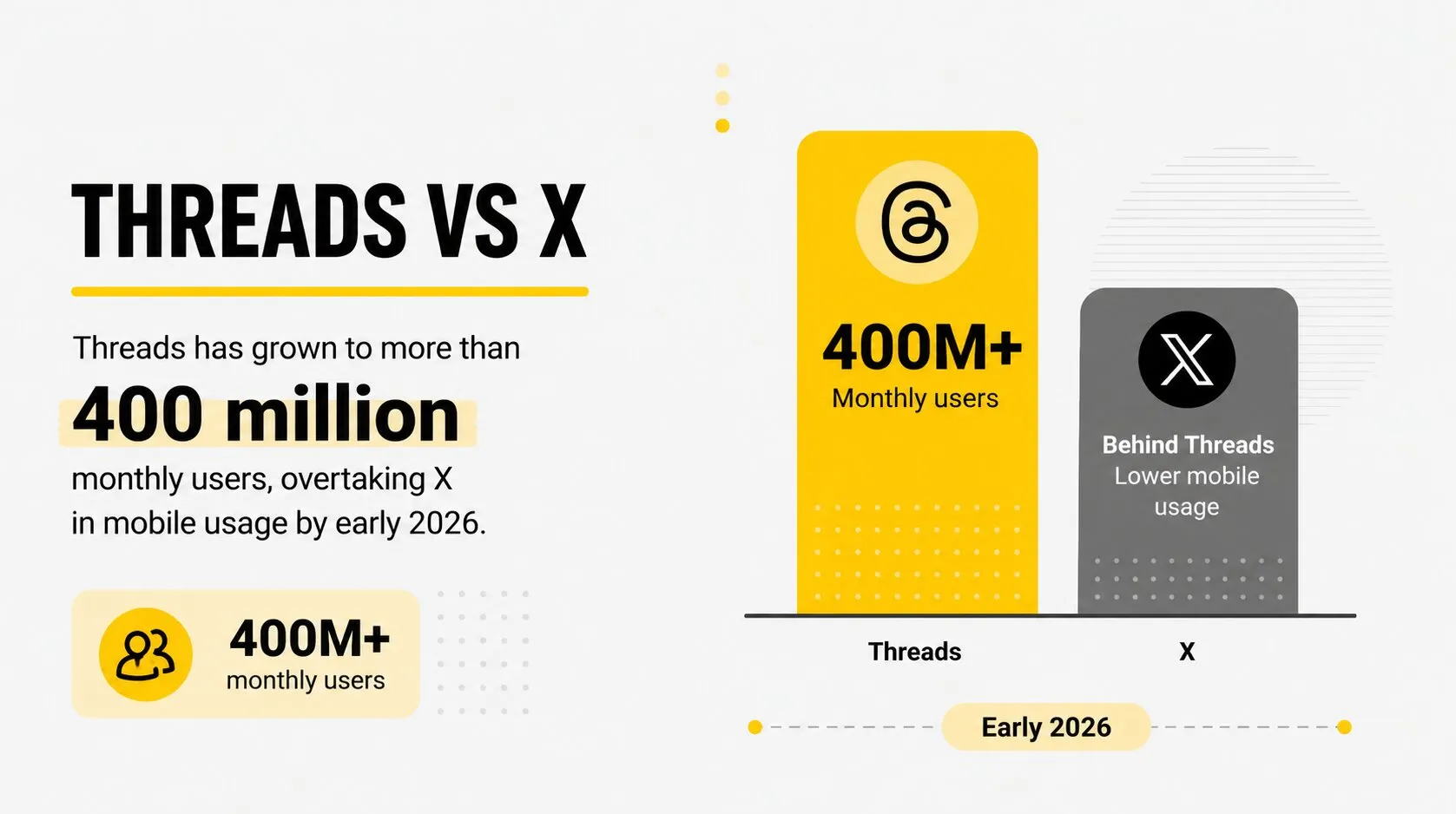
In the meantime, Threads had over 400 million monthly active users in Q3 2025 and surpassed X in mobile use in January 2026, suggesting that platform orders can change much more rapidly than long-term tactics can evolve. Channel resilience, having a presence across multiple platforms, and building audience-owned channels in addition to social, is not "insurance". It is basic strategic hygiene.
Social Media Marketing Advantages and Disadvantages: B2B vs B2C
The pros and cons covered in this article do not apply equally to every business. For B2B companies especially, social media marketing operates under different conditions, different platforms, different buyer behavior, and a different definition of what success actually looks like.
What Works Differently for B2B Companies
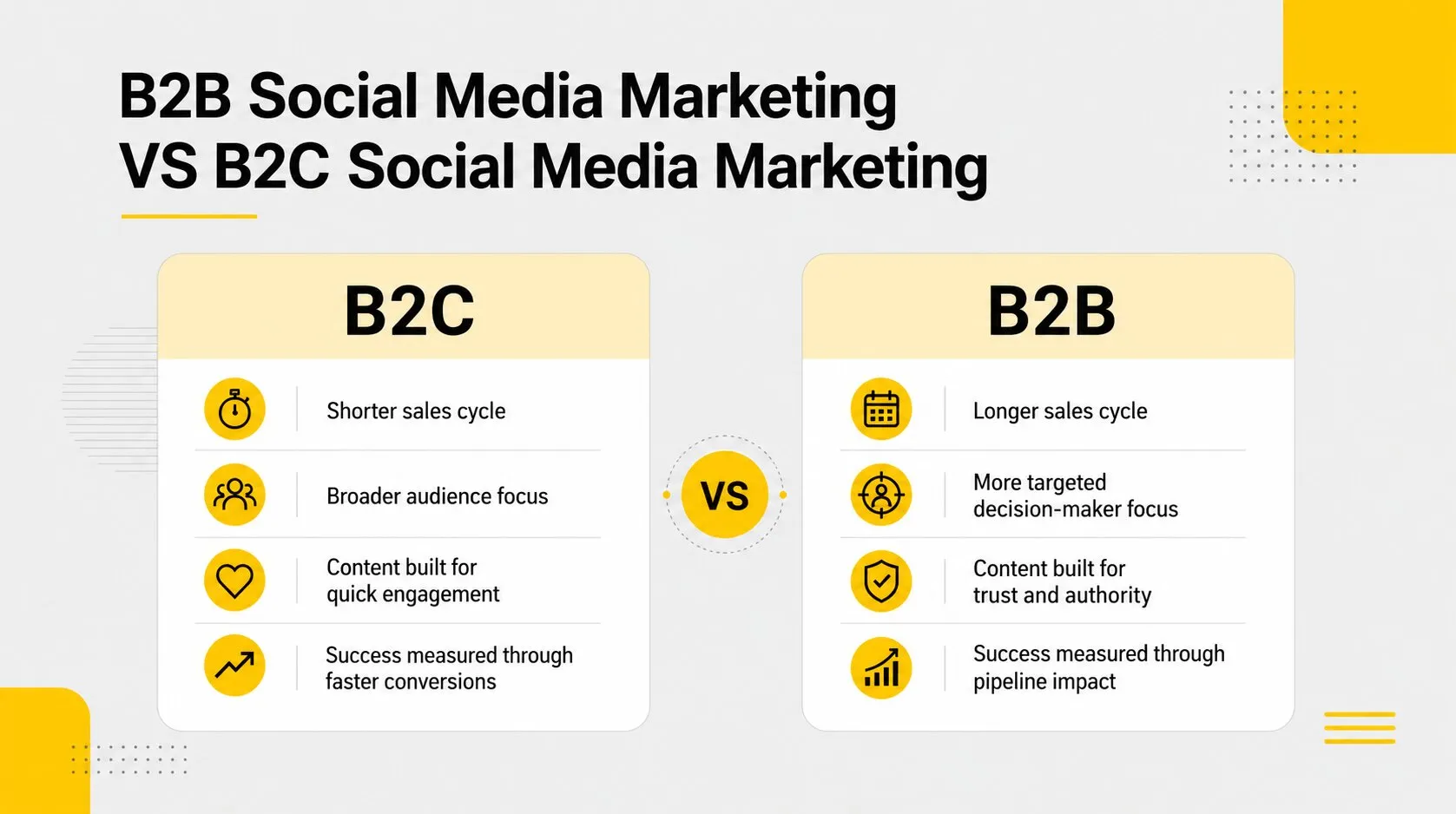
The core difference is the sales cycle.
In B2C, social media can be used to make a sale in a single visit. A customer sees a product, clicks on it, and purchases it. In B2B, it takes a village of people (multiple stakeholders), months of the evaluation process, and trust building before sales are even engaged. Social media is part of the process, but not the final step.
This changes how the advantages land:
- Brand awareness still matters, but it has to reach the right professionals, not just a broad audience
- Direct audience access is valuable, but the content that earns engagement from a CFO or VP of Operations looks nothing like what performs on a consumer feed
- Market intelligence through social listening is arguably more powerful in B2B, where understanding competitor positioning in a niche market can directly inform sales strategy
This also changes how the disadvantages cut:
- Negative feedback in a tight professional community travels faster and sticks longer than a consumer complaint
- ROI attribution is harder to defend when a social media touchpoint may not convert for six months, and through multiple other channels
- Content saturation is a different problem when your buyers are reading industry-specific material rather than entertainment content.
The biggest mistake B2B companies make on social media: applying B2C logic to a B2B context, chasing follower counts, optimizing for entertainment value, and measuring success by reach and likes rather than by audience quality and pipeline contribution.
Platform Recommendations for B2B
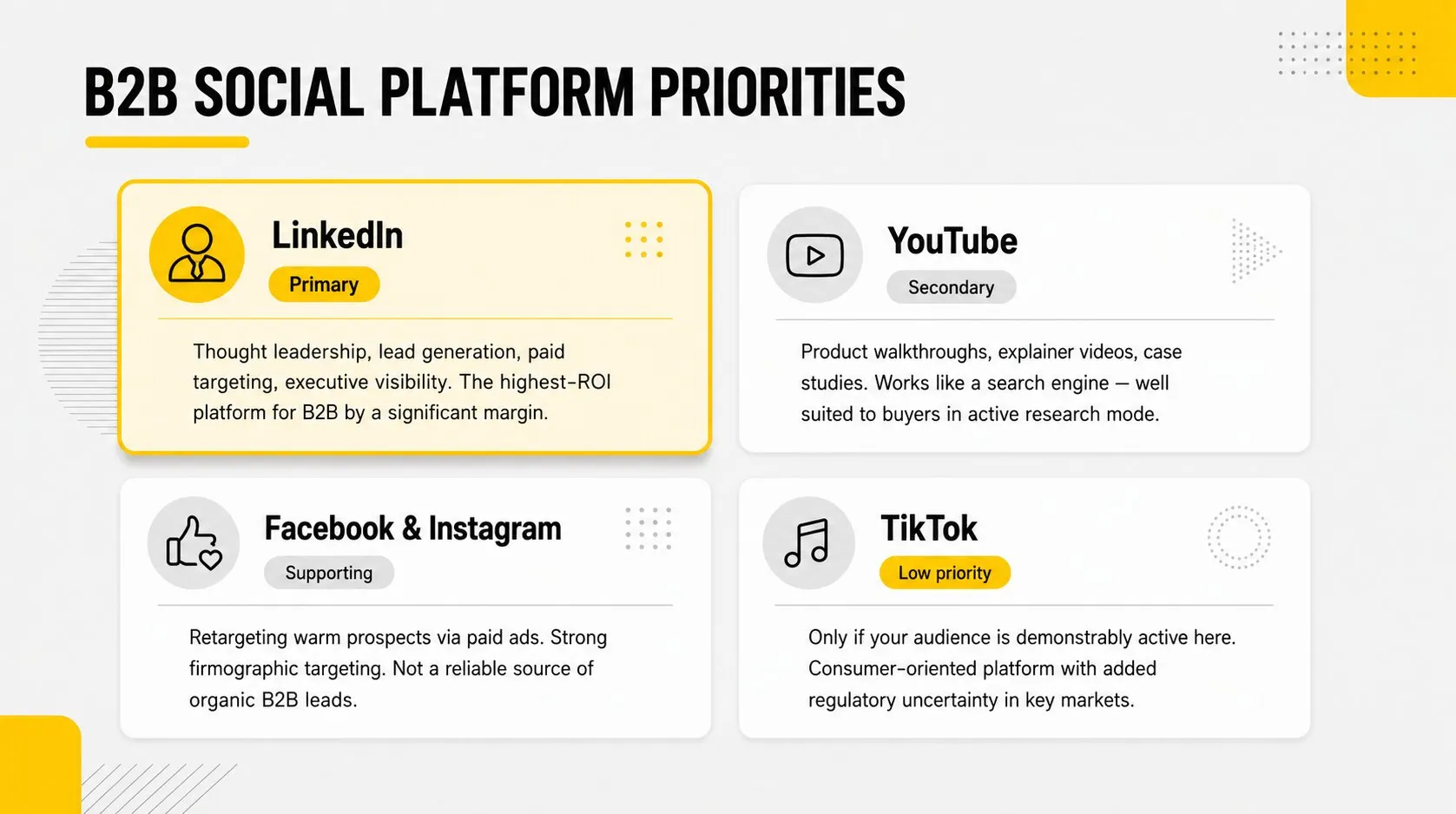
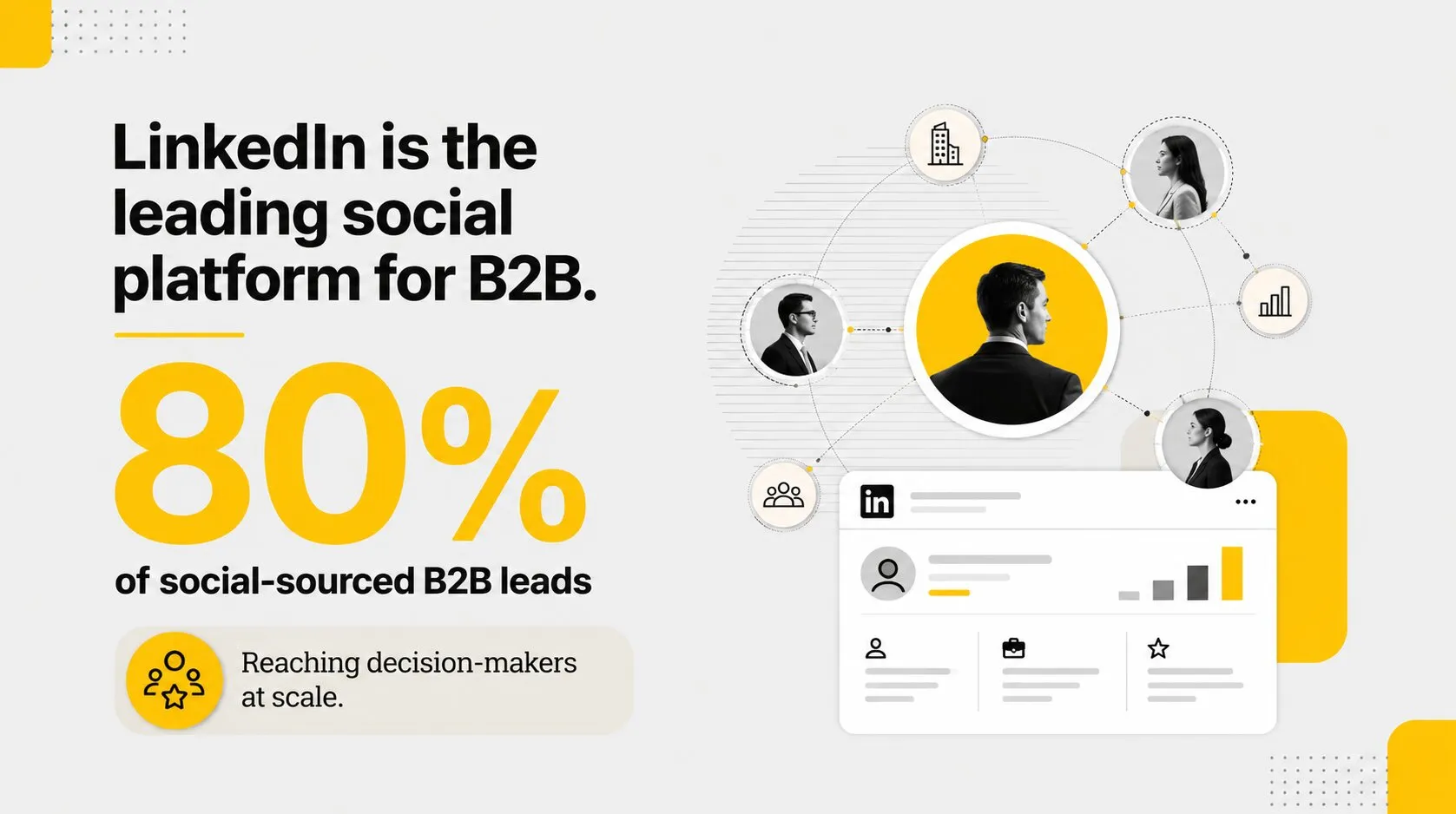
LinkedIn is the clear priority for B2B.Four out of five LinkedIn members drive business decisions at their organizations, and the platform generates 80% of all B2B leads that originate from social media. 97% of B2B marketers use LinkedIn for content marketing, making it the closest thing to an industry consensus in the B2B space.
YouTube works well as a secondary channel. Because it functions more like a search engine than a social feed, it suits longer B2B buying cycles where prospects are actively seeking specific information rather than passively scrolling.
Retargeting is more effective on Facebook and Instagram than prospecting. Their paid ad targeting can even go into specific job positions, industries, and company sizes, which makes paid ads a good complement to LinkedIn. B2B lead generation, however, is not typically feasible via any of these platforms in the organic space.
For most B2B companies, TikTok is still a low priority. Some brands have established audiences with educational short-form content, but the platform's consumer focus and regulatory concerns in several key markets mean it isn't easy to justify to the powers that be as a core B2B platform.
The fundamentals apply in both B2B and B2C: know your audience, create content that serves them, measure what maps to actual business goals. But the execution looks very different, and recognizing that difference early saves considerable time and budget.
Is Social Media Marketing Worth It? How to Decide
The honest answer is: it depends. Social media works well for many businesses and poorly for others, and the gap is rarely about the platforms. It comes down to fit: the right channel, audience, goal, and capacity to execute.
Decision Framework: Questions to Ask Before Investing
As you consider spending time and money, ask yourself these four questions:
1. Is your audience on social media, and on which platform? More than 5.24 billion people use social media, so it's likely. A better question is, is your target audience on the social platform you're contemplating, and do they use it to decide on or research products like yours?
2. What does success look like, and how will you measure it? Engagement is easy to track but hard to connect to revenue. Define what you are optimizing for: leads, awareness, retention, traffic, and decide how you will attribute social media's role before you start. Without this, you will spend months with no clear signal of what is working.
3. Do you have the resources to be consistent? An account that is irregular and unengaged with the audience is often worse than no account. Don't overestimate what you can do each month, not just each week.
4. Is social part of your marketing strategy or the only one? Social media is rented out. Platform instability, algorithm changes, and organic reach erosion are ever-present. Those who develop their brand on just one platform are the most vulnerable.
Signs Social Media Marketing Is Right for Your Business
If most of the checklist above applies to your business, social media marketing is worth a genuine investment. If fewer than half apply, your time and budget may generate better returns in other channels first.
A Brief Note on Weighing ROI vs. Risk
Social media marketing isn't inherently risky, but it will be labor-intensive compared to how it's sometimes sold. The risks are present and controllable but need to be managed. It is typically those who use social media as a broadcast medium rather than a monitored medium who get into trouble.
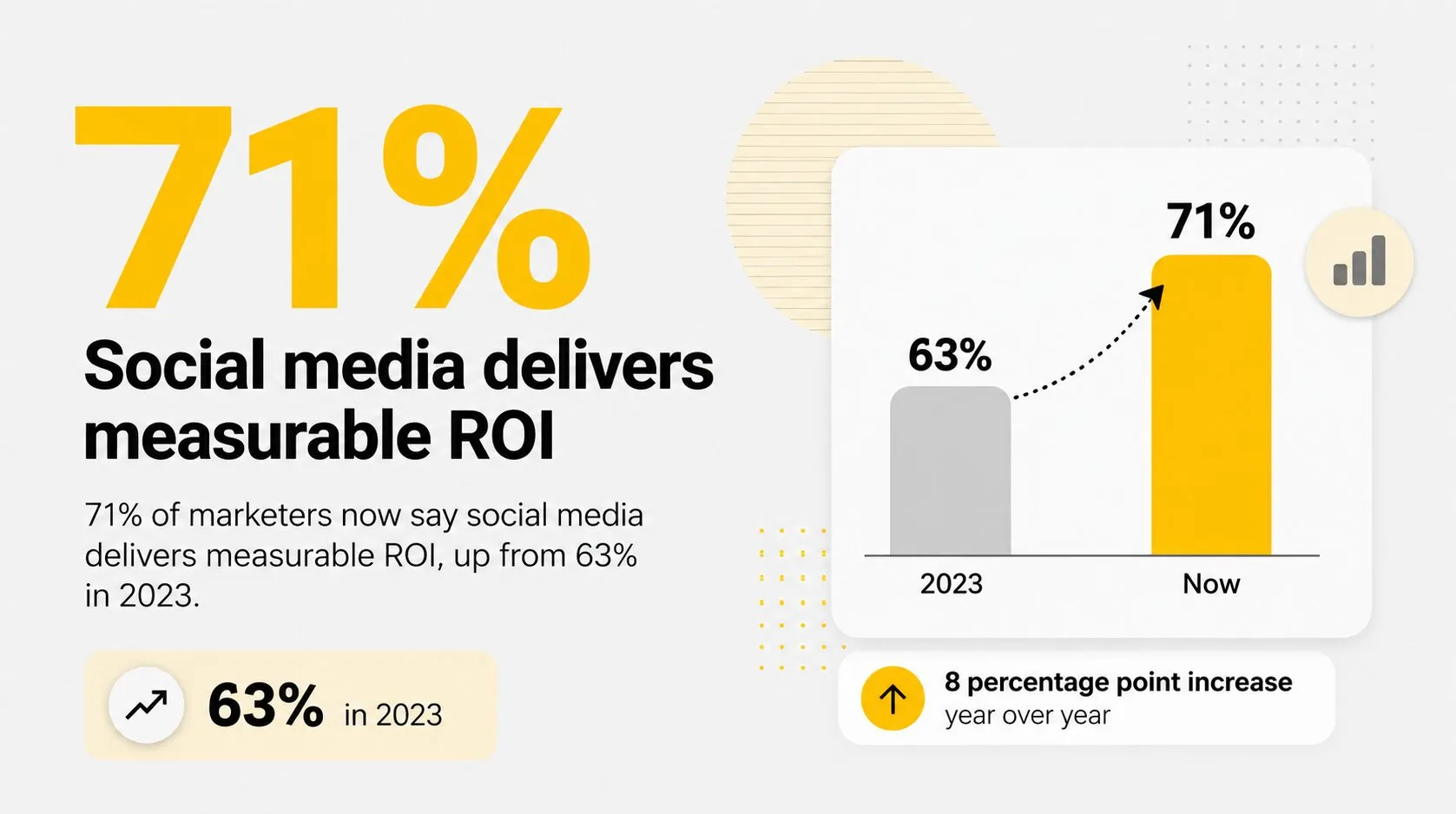
It's good news on the reward front. 71% of marketers now believe social media offers measurable return on investment (ROI), up from 63% of marketers in 2023, due to the advancement in social media measurement and attribution.
The best approach: begin with one platform and do it well, determine how you will define success before you start, allow it time (at least three to six months) to grow and learn, and then take stock before you expand. Social media marketing is more about quality and strategy than it is about quantity.
Ready to Put Social Media Marketing to Work for Your Business?
Social media marketing is a hugely valuable strategy for B2B businesses. When done wrong, it's a waste of time and money. The difference is nearly always strategy - what platforms are relevant for your target audience, what content will resonate with that audience, and how to track the metrics that matter.
As an AI-powered B2B growth company, AI bees understands that no two businesses face the same social media challenges. Whether you're trying to build brand awareness with decision-makers, generate qualified leads through LinkedIn, or figure out which channels deserve your investment, the right approach depends entirely on your buyers, your sales cycle, and your growth objectives.
We don't create one-size-fits-all social media strategies. We create strategies for your market, leveraging AI-powered insights and data to understand where your audience is, what will work in terms of content, and how to use social media to drive pipeline.
If you want a clearer picture of how social media marketing fits into your B2B growth strategy and where the biggest opportunities lie for your business specifically, we'd like to show you what that looks like in practice.
Book a Free Demo and let's build a social media strategy that works for your business.
FAQs About the Advantages and Disadvantages of Social Media Marketing
1. What is the single biggest advantage of social media marketing?
The strongest advantage is the combination of scale and targeting precision. While the global audience of over 5.24 billion social media users is immense, the true strength of these platforms lies in their precision. Businesses can bypass broad reach in favor of granular targeting, connecting with individuals based on specific criteria such as job title, industry, and purchase intent. This level of focused exposure provides a unique combination of scale and efficiency that traditional advertising channels struggle to match at a similar price point.
2. What is the biggest disadvantage of social media marketing?
For most businesses, the biggest disadvantage is algorithm dependency. Your ability to reach your own audience depends entirely on decisions made by platforms you don't own or control. As covered in this guide, Facebook's average organic reach sat at just 1.37% in 2024, meaning most of your followers simply won't see your content unless you pay to promote it. That reality has fundamental implications for any strategy built around organic social media alone.
3. Is social media marketing worth it for B2B companies?
Yes, but platform selection matters enormously. B2B buying cycles are longer, and audiences are more specific, which means not all platforms are created equal for B2B goals. LinkedIn is where the evidence consistently points to four out of five LinkedIn members driving business decisions at their organizations, and 97% of B2B marketers use it for content marketing. Applying B2C tactics on consumer-oriented platforms is the most common reason B2B social media investment fails to deliver.
4. How do you measure the ROI of social media marketing?
This is one of the genuine challenges the article covers in depth. Only 30% of marketers say they can actually measure social media ROI, not because it can't be done, but because social media typically influences buyers across multiple touchpoints before conversion. The most reliable approach is to define your success metrics before you start, build the right tracking infrastructure, and measure outcomes that connect to actual business goals, such as pipeline contribution, lead quality, and customer retention, rather than surface-level engagement metrics alone.
5. What is the difference between organic and paid social media marketing?
Organic social media is content you post for free on social media platforms, which is distributed via algorithms. Paid social is a paid promotion to target a specific audience beyond your current fan base. Most marketing campaigns use both. Organic content is the foundation for trust and engagement; paid promotion helps you reach more people and get quicker results. Given the significant drop in organic reach across all major platforms over the past few years, paid social promotion has become almost essential for many businesses that want to be successful with social media marketing.
Checklist for Successful Social Media Marketing
Download now
Make Loss Impossible
with Performance-Based Marketing

Personalized Campaigns with
Precisely Selected Prospects
.svg)
Analysis From Your Dedicated
Account Manager

with a Team of Growth Hackers
we Develop your Tailor-Made Strategy
.webp)


%201.svg)
.svg)


.svg)
.svg)


.webp)