
.svg)







The sales team is overwhelmed with leads, but the pipeline tells a different story; it’s empty. Ring any bell?
The majority of B2B businesses are caught up in what we term the ‘more leads’ trap. Their strategy is to go for quantity, rejoice in vanity numbers, and then be confused about the steady decline in their conversion rates. The hard truth is that one thousand warm leads will never trump fifty hot prospects who need what they are selling.
This isn’t another generic resource chock-full of strategies you've probably already tested. What you’ll take away with you is a replicable, data-supported framework engineered to draw in qualified leads who have your Ideal Customer Profile in mind. No more throwing darts at a dartboard.
But before we get any further, let's get down to basics on what we are really pursuing.
What constitutes a quality lead in a B2B environment? A quality lead for a business-to-business sale is one that shows three key qualities: a strong fit for your Ideal Customer Profile, buying intent, and a clear next step in the sales process. Without these three, you are simply gathering business contacts, not building your pipeline.
Now, let's break down exactly how to find them.
What Are High-Quality Leads?
What constitutes high-quality B2B leads is that they are prospects who are very similar to your Ideal Customer Profile, show strong buying intent, and have the authority and budget to make purchasing decisions. Unlike the number of leads, high-quality leads have a chance to become paying customers, which makes them the real fuel for predictable revenue growth.
That is the definition. But what does it look like in practice?
The Five Markers of a High-Quality Lead
If you look past the marketing buzzwords, the best leads will always have a set of qualities in common. These are not random boxes to be ticked – these are the elements that will decide whether a lead will progress through your pipeline or get stuck there forever.
- Budget alignment: The prospect’s organization is financially able to afford your solution. Budget alignment might be indicated by factors such as company size, funding stage, and tech stack. Pursuing enterprise business with a start-up budget is a waste of time for everyone concerned.
- Decision-making authority: The leader either has the purchasing power or has the direct influence over the person who does. You wouldn't be building a relationship with someone who doesn't have the authority to say yes.
- Genuine need or pain point: The best leads are not people who are curious but those who are already experiencing a pain that your product can relieve.
- Timeline fit: A prospect may fill all the boxes, but with an eighteen-month buying timeline, they are not a quality lead at this moment. A real pipeline lead will sync with your sales cycle.
- Company size and industry match: You are selling to accounts in which your product provides real value. You are trying to sell an enterprise solution to a company with only ten people. That is just not going to work.
If the lead meets all five markers, your sales team isn't persuading anyone. They are only leading a willing buyer to the decision.
MQLs vs SQLs vs High-Quality Leads: What's the Difference?
.webp)
These three terms get used interchangeably, but they represent very different stages of qualification.
These three terms are used interchangeably, but they are completely different levels of qualification.
The takeaway? The best leads are the subset of SQLs that your top reps would actually want on their calendar. They're not just qualified leads, they're ready to buy.
The goal of maximizing MQL volume tends to be counterproductive to pipeline quality. When the marketing department is rewarded for the number of leads and the sales team is measured for closed deals, it is bound to create alignment issues. Prioritizing quality in the leads right from the beginning ensures that both teams are aligned.
Why Lead Quality Matters More Than Lead Quantity
It’s easy to feel productive when chasing lead volume until you see the numbers. The marketing team is thrilled about a record-breaking month of form fills. The sales team is stoked about a full pipeline. But then comes the harsh reality: most of those leads stop responding, and those who do are not a good fit.
This is a pattern that repeats in B2B companies around the world, and it’s costing more than most teams think it is. The numbers paint a clear picture: the “better is better” strategy trounces the “more is better” strategy on every single metric that actually matters.
The Conversion Gap Is Real
The closing rate for businesses that prioritize quality over quantity can reach as high as 40%, while businesses trying to convert low-quality or high-volume leads are lucky to reach double digits. A business can improve its closing rate by as much as 40-60% just through quality lead qualification.
.webp)
The math is simple: fifty qualified leads will make more money than five hundred leads that were never intended to make a purchase.
The True Cost of Chasing Volume
Customer acquisition cost doesn’t lie. When your pipeline is full of low-fit prospects, you’re paying to acquire leads that will never convert.
- Ineffective lead scoring can result in up to 35% of a salesperson’s time being wasted, with an annual cost of approximately $39,000 per salesperson.
- Overloaded pipelines with low win rates can waste 80–90% of marketing and sales budgets on deals that never close.
- Longer sales cycles mean depleted resources, as salespeople spend weeks qualifying leads who were never near a point of purchase decision.
The paradoxical truth? The more you spend per lead on better sources, the more your CAC will decrease because conversion rates will improve significantly.
Your Sales Team Is Paying the Price
There is a human element to pursuing bad leads that rarely gets represented in strategy decks.
When sales reps are making calls to prospects who never had a chance of being a good fit, rejection becomes less of a job requirement and more of a personal issue. Confidence wavers. Motivation falls. Your top reps will begin to wonder if there’s something wrong with them, when in reality, they’ve just been given a list of people who aren’t going to buy from them anyway.
In fact, high-quality leads not only convert at a higher rate, but they also save your team’s energy and keep your brightest minds on board.
Revenue Predictability Starts with Pipeline Quality
Poor leads make unpredictable pipelines. One quarter is full of promise; the next is a disaster because “half your opportunities never were.”
.webp)
The fact is that the companies practicing Account-Based Marketing have a 60% higher success rate in achieving their objectives because they focus on quality from the very beginning. When all leads in your pipeline qualify for quality, the process of forecasting becomes a prediction rather than a guess.
How to Qualify Leads Faster Using Data Signals
While gut instinct certainly has its place in sales, it's an awful way to evaluate prospects on any kind of scalable basis. The best B2B teams have their data do all the heavy lifting up front, deciding who's worth calling and who's simply browsing before their reps ever dial up a prospect.
The following is a basic outline for reading the signals from genuine buyers versus tire kickers:
Of course, while “gut instinct” has its place in sales, it’s a terrible way to qualify leads. To put it briefly, the most efficient B2B sales organizations are the ones that let the data do all the heavy lifting to qualify a prospect before they ever speak to a rep.
The following explains how to read the signals of true customers and distinguish them from the tire kickers.
Behavioral Signals That Indicate High Intent
Not all website visitors are created equal. Someone who views a homepage and then bounces is a very different visitor from someone who continues to come back and drill deeper. The behaviors that matter most are the ones that mirror how actual buyers research solutions.
High-intent actions to track:
.webp)
- Multiple website visits: Engagement of a prospect visiting a website three or four times in a week shows they're considering the brand, while one-time visits would not lead anywhere.
- Pricing page views: This is probably the strongest-buying-signal metric of them all, since a visitor isn’t likely to view pricing unless they’re serious about making a purchase.
- Case Study / ROI Content Downloads: These prospects are building their case. They want to justify their spend internally.
- Demo or contact page visits: Even if they haven't filled out a form, reaching these pages means they are close to raising their hand.
Email communication also shows a similar trend when we consider a prospect who consistently reads our emails, engages with them, and writes back to our communication versus one who simply does not read our messages. For one, we can measure "opens." While we cannot measure "clicks," we should definitely monitor "replies."
Firmographic Fit Indicators
A goal without fit is a dead end. Your prospect may be super interested, but if their company is in the wrong industry, wrong company size, or wrong budget for your solution, forget about closing a sale with them.
First start with matching leads against your ideal customer profile. If you don't have an ideal customer profile established yet, that will be the starting point of creating the others.
Aside from basic firmographics, try to find growth indicators that signal the firm is likely to become a buyer in the near future.
- Recent funding rounds: Companies that have recently secured funding are now investing.
- Hiring activity: A firm that is hiring in areas your product can help (sales, marketing, operations), particularly, has an urgent budget.
- Expansion news: In general, changes in the marketplace, the establishment of new offices, or organizational changes may prompt the evaluation of various vendors.
These signals inform you not only if a company fits, but also when they are fitting in.
Engagement Scoring in Real-Time
Signals are useful to track. The art happens when we are able to specifically act on them.
The objective is simple: to determine a scoring system for actions or leads and have them move up or down based on that behavior.
How to weight different actions:
- High-value actions (10–20 points): visit pricing page, request demo, download case study, response to outreach.
- Medium-value activities (5–10 points): Visiting a site multiple times, clicking through an email, registering for a webinar
- Low-value activities (1–5 points): Page view, open email, social media follow
After you have decided on your weights, you can then set your sales handoff threshold. For instance, in cases where the sales lead is above 50 points, it can be handed over to the representative within 24 hours. Anything below that can continue in the marketing nurture stage.
The key is in calibration. Looking at your closed-won deals every quarter and asking what those leads did before they closed is a great way to go. Make sure you are scoring your model based on what truly predicts revenue, not what makes sense.
Negative Signals to Disqualify Early
Knowing who not to pursue is just as valuable as knowing who to pursue. Disqualifying bad leads early on saves your team hours of wasted time.
Red flags to watch for:
.webp)
- Personal email domains: Gmail, Yahoo, or Hotmail emails, while present, would be unlikely to represent decision-makers, but rather individual researchers.
- Industry or Company Size: If these don’t match your ideal customer profile, do not force it. High engagement levels will not make up for disconnects in these areas.
- Job titles without authority: Maybe interns or junior staff may access your content to do research, but they are not signing any contract.
- Prolonged Low Engagement: You cannot call a lead who has been in your system for months a "warming lead." They're not a lead anymore if they haven't engaged with anything in months.
Build these disqualification rules into your scoring system as negative points: a personal email address might subtract 15 points; a wrong industry could be an automatic removal from sales follow-up.
The result? Your reps spend time on leads that can actually buy, and your conversion rates climb.
7 Data-Driven Strategies to Generate High-Quality Leads
Tactics without data are just guesses. The strategies below work because they're built on signals, patterns, and feedback loops not assumptions about what might attract the right buyers.
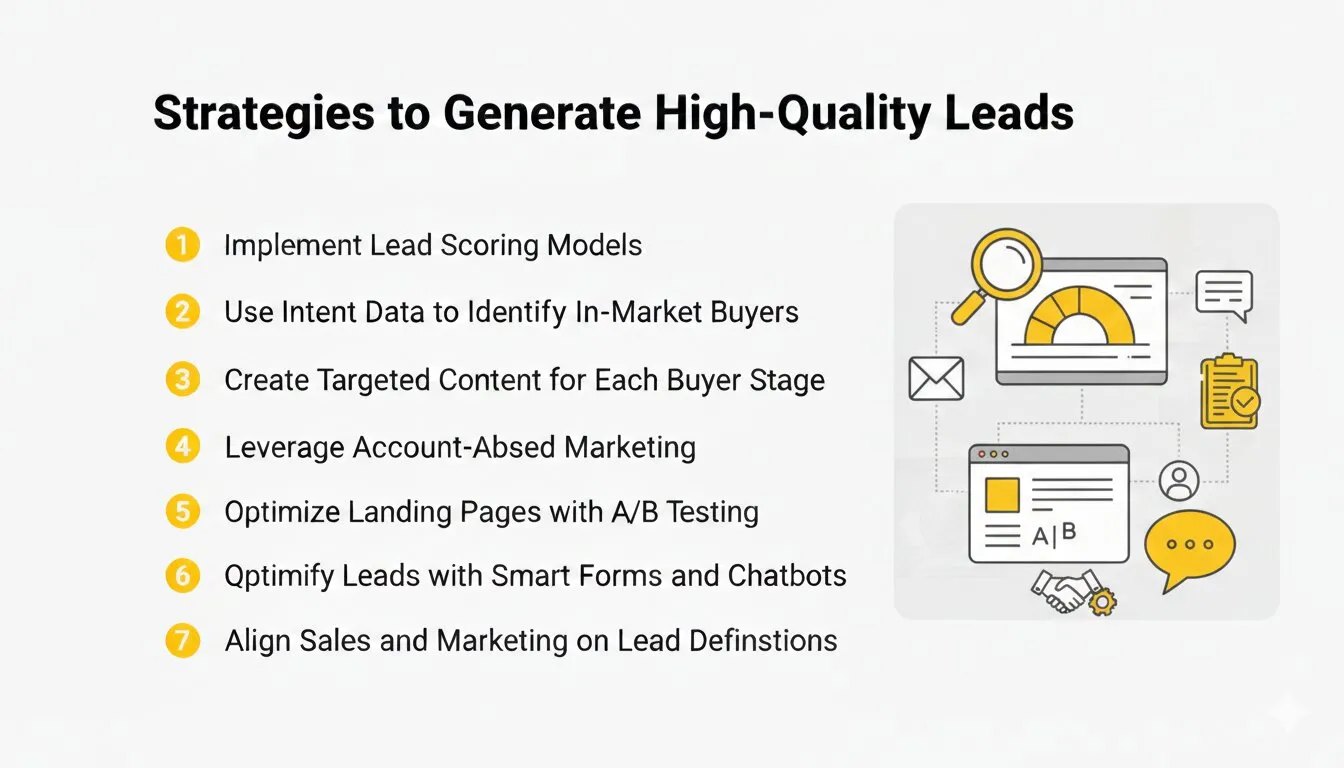
1. Implement Lead Scoring Models
What Is Lead Scoring? The assigning of numerical digital values to each potential lead in relation to their probability of converting qualifies as lead scoring. The higher a lead is scored, the closer it is to converting.
Most effective models feature two dimensions:
Behavioral scoring analyzes what your lead is engaging with. This means knowing what your lead is doing. If your lead visited your pricing page three times in the last week, well, that is different from someone who visited your blog once six months ago.
Demographic scoring looks at the person the lead is. What's their job title? What's the company they're working with? A director with a mid-market company has a higher score than a student with a company email who has the same actions.
Implementation tips:
- Start with five to ten key actions and attributes, and build from there.
- Review closed-won opportunities to determine the signals that predicted conversion.
- Establish clear thresholds that initiate a sales-handoff or continue nurturing.
2. Use Intent Data to Identify In-Market Buyers
Imagine knowing the companies that are actively researching organizations like yours, companies that are looking for alternatives such as yours, even if they've yet to visit your site. This is what intent data can deliver.
First-party intent data includes data collected within their own site, email interactions, and content downloaded. Highly accurate, but only includes the people you have already acquired.
Third-party intent data can come from companies such as Bombora or G2 and can reveal which companies are researching topics that relate to your solution across the web, even if they have never heard of you.
How to act on intent signals:
- Focus on the accounts that display intent spikes before reaching the competitors.
- Tailoring the message to what they're actually researching.
- Place intent data on top of some or all of your ICP characteristics. The truth is, high intent for a poor-fit account is still a dead-end.
3. Create Targeted Content for Each Buyer Stage
Buyers at various stages require various things from the information that attracts them. This information must suit the various stages.
Top of Funnel (TOFU): Awareness. Awareness stage. These are educational blog posts, industry reports, and thought leadership.
Middle Of Funnel (MOF): Consideration Stage. Comparison guides, webinars, and in-depth case studies. Assist them in evaluation and positioning your approach as the smart decision.
Bottom of Funnel (BOFU): This is the stage where the decisions are made. Product demos, ROI calculators, testimonials, and free trials. Eliminate friction and make it easy to say "yes."
The quality connection: TOFU content attracts volume. MOFU and BOFU content attract qualified volume. If your strategy skews too heavily toward awareness, you'll drive in leads that aren't ready to buy.
4. Leverage Account-Based Marketing (ABM)
The conventional lead generation casts a very wide net. ABM reverses the model, and you will select your target accounts and then create campaigns targeting them.
ABM is a company that designates quality over quantity. You are only selling to accounts that fit your ICP, so there is no wasted time spent on the companies that will never be able to close. A Survey Report also states that the win rates of companies that align ABM and Account-Based Advertising increase by 60%.
.jpg)
Most programs fail at personalization at scale. The solution is tiered:
- One-on-one best dream narratives with entirely customized outreach.
- One-to-few on clusters of similar accounts in terms of industry or challenge.
- One-to-many on the wider list with dynamic content and industry-specific messaging.
ABM requires a significantly more coordinating effort, but the leads produced by it have much higher chances of conversion.
5. Optimize Landing Pages for Conversion
It is possible to generate all the correct traffic up to the point where your landing pages are unresponsive, and the result is a loss of qualified leads.
Form length and friction: Each field minimizes conversions. TOFU offers brief forms. In case of demos or consultations, longer forms can be accepted. Test relentlessly.
Clarity of value proposition: Visitors of the site must know what they are getting in just a few seconds. It is not about the feature but the benefit.
Social proof placement: Testimonials and logos lower the risk. Locate them close to your call-to-action, so individuals can make a decision whether to submit or not.
6. Qualify Leads with Smart Forms and Chatbots
Information is captured in the form of statutes. Smart forms and chatbots are real-time qualified.
In progressive profiling, the information is gathered over many interactions. First visit: name and email. Second visit: company and position. With the third interaction, you have a complete profile without a ten-field form.
Chatting qualification is achieved using chatbots that inquire about qualifying questions in a natural manner. A properly developed bot can inquire regarding time frame, number of individuals, or decision-making authority, and then forward hot leads to sales or book appointments automatically.
Chatbots do not simply generate leads. They pre-qualify them.
7. Align Sales and Marketing on Lead Definitions
All these strategies will be useless when sales and marketing do not agree on the definition of a qualified lead.
The handoff is formalized through service-level agreements (SLAs). A good SLA defines:
- What does a lead have to fulfill before it is sent to sales (MQL definition)
- Speed of following up on the sales.
- How will feedback sales contribute to the quality of leads?
Long-term, it works through feedback loops. Sales reports that converted and why. That feedback is used by marketing to fine-tune the targeting and scoring. Reviews of the pipelines monthly ensure that both teams are on track.
Once sales and marketing work as a single revenue team, lead quality ceases to be a source of conflict- and a joint victory.
Key Metrics to Measure Lead Quality
You cannot improve what you do not measure. The problem is, most B2B teams measure everything except what actually matters.
.webp)
A dashboard full of vanity metrics looks great in Monday morning meetings. “Lead volume is up!” “Website traffic is increasing!” “More forms are being filled out!” But that doesn’t tell you if the right people are entering your funnel.
These five metrics cut through the clutter. They show you whether your lead gen efforts are actually attracting real buyers with real intent, or just inflating your CRM with people who will never convert.
Putting These Metrics to Work
The table above provides you with the formulas. Now, let's talk about how you can actually use these.
Leads that convert to opportunities are the most obvious quality indicator. If you're converting less than 10% of your leads to opportunities, you know your filters are not working correctly, either in targeting or qualification.
Sales cycle length will also provide you with hidden quality insights. You might know that one channel converts as well as another, but if one channel closes in three weeks while another closes in three months, that's a huge difference in cost for your sales team.
CLV by channel will also surprise you the most. You might know that your paid ad strategy converts really fast, but if you know that those customers will only stick around for six months, you might realize that your "expensive" content strategy is the better choice after all.
CPQL is more important than CPL. It costs you a lot more to have a cheap lead that will never qualify than it would to have a more expensive one that converts.
Scoring accuracy will keep you honest. You should review this every quarter against
Tools for Data-Driven Lead Generation
Strategy is only as good as the tools that execute it. The right tech stack does not simply automate tasks. It reveals the insights that enable quality-focused lead generation.
.webp)
Here's what a modern B2B lead gen toolkit looks like.
CRM Platforms
Your CRM is at the core of it all. It's where lead data lives, lead scoring happens, and sales handoffs are tracked. Without a clean, well-maintained CRM, all other tools underperform.
What to look for: Native lead scoring, pipeline visibility, flexibility in integrations, and reporting to connect marketing to revenue.
Popular choices: Salesforce, HubSpot CRM, Pipedrive, Zoho CRM
The best CRM for you is the one that your sales team actually uses. Features don't matter if no one wants to use them.
Marketing Automation Tools
These tools enable lead nurturing on a large scale by providing the right content to the right lead at the right time without any human intervention.
What to look for: Behavioral triggers, email sequencing, lead scoring integration, and dynamic content.
Popular options: HubSpot Marketing Hub, Marketo, ActiveCampaign, Pardot
Automation takes care of the middle of your sales funnel. It keeps leads engaged until they are ready to talk to sales, so salespeople are not wasting their time on leads that need more nurturing.
B2B Data and Intent Providers
This is where quality-focused lead gen really gets serious. Data providers help you find out who fits your ICP, and intent providers help you find out who is actively looking for solutions like yours.
.webp)
What to look for: Data accuracy, real-time verification, firmographics, technographics, and intent signals.
Popular options: AI Ark is definitely worth checking out in this space. It's an AI-powered B2B data platform that enables you to target your audience with precision using firmographics, technographics, and signals. Other options include ZoomInfo, Bombora, Cognism, and Clearbit.
With fit data and intent signals, you can finally prioritize who to reach out to based on who fits your ICP and who is actively looking to buy—no more guessing games.
Analytics and Attribution Tools
You can't optimize what you can't measure. Analytics tools will reveal to you which channels, campaigns, and content are actually driving qualified leads, not just traffic.
What to look for: Multi-touch attribution, conversion path analysis, and tying marketing spend to pipeline and revenue.
Popular options: Google Analytics 4, Dreamdata, Bizible, HubSpot Attribution
B2B marketing involves many touchpoints before conversion. Single-touch models don't account for most of this.
Building Your Stack
You don't need all the tools right away. You need the basics:
- CRM: Get your data house in order
- Marketing automation: Scale your nurture, not headcount
- Data/intent provider: Better targeting and prioritization
- Attribution: Figure out what actually works
Add complexity only after you've outgrown the simple solutions. A lean and well-integrated stack is better than a bloated one, every time.
Generate Better Leads, Close More Deals
As you now realize, lead generation isn't about quantity; it's about quality.
The companies that are succeeding in B2B marketing are not the ones that have the largest lists. They're the ones that have the most focus: the right targets, reading the right signals, and giving their sales teams a list of leads that are actually ready to buy.
From understanding the definition of a high-quality lead to executing on lead scoring, intent data, and more, all of the strategies presented in this guide are leading to one conclusion: when you focus on quality, everything else falls into place. Conversion rates go up. Sales cycles get shorter. You're not wasting your time chasing leads that are never going to convert.
However, knowing what to do and having the bandwidth to do it are two different things.
That's where AI bees comes in. We leverage AI targeting with best-practice, data-driven approaches to provide you with leads that not only match your ICP but also have a strong buying signal, so your sales team only talks to leads that convert.
Book a demo and let's build a pipeline that drives predictable revenue.
FAQ For How to Generate High-Quality Leads
1. What is a high-quality B2B lead?
A high-quality B2B lead is one that closely matches your Ideal Customer Profile, demonstrates genuine buying intent, and has the budget or authority to decide on a purchase. Unlike general leads, high-quality leads have a natural way of converting into paying customers; they are the foundation of predictable revenue growth.
2. How do you generate high-quality leads for B2B?
You generate high-quality B2B leads by combining data-driven strategies like lead scoring, intent data, targeted content, and account-based marketing. The key is focusing on prospects who fit your ICP and show active buying signals rather than chasing volume with broad campaigns.
3. Why does lead quality matter more than lead quantity?
Because low-quality leads waste time, burn budget, and exhaust your sales team. Companies that prioritize lead quality see close rates as high as 40%, shorter sales cycles, and more predictable pipelines. Fifty qualified leads will always outperform five hundred that were never going to buy.
4. What data signals indicate a high-quality lead?
The strongest signals include multiple website visits, price page views, case study downloads, and email engagement. Coming to the firmographic level of signals, one should focus on ICP fit, recent funding rounds, and hiring within areas where the product can help solve.
5. How do you measure B2B lead quality?
With metrics like lead-to-opportunity conversion rates, sales cycle length by lead sources, customer lifetime value by lead sources, and cost per qualified lead, you can understand if your leads are actually driving revenue for the business or simply going into your CRM system.
High-Quality Lead Checklist
Download now
Make Loss Impossible
with Performance-Based Marketing

Personalized Campaigns with
Precisely Selected Prospects
.svg)
Analysis From Your Dedicated
Account Manager

with a Team of Growth Hackers
we Develop your Tailor-Made Strategy




%201.svg)
.svg)


.svg)
.svg)


.webp)